By Melanie Nathan, July 29, 2026: First published here.
For those who may have missed it, Boy George has released a new song, We Will Dance Again (Od Nirkod). Inspired by the victims of the October 7 massacre, it is both a tribute and a statement against antisemitism. It also provides Pride organizers with an unexpected opportunity to rediscover what Pride was always meant to be. Every Pride organizer looking for a headline act should pick up the phone and call Boy George – now!
Not because everyone would agree with him and may because they won’t.
The irony is almost too delicious to ignore. The man who gave us Culture Club, (1981) a band whose very name celebrated people from different cultures, religions, races, and identities coming together, has become one of the few artists willing to remind us that diversity is supposed to include diversity of thought. Perhaps couched in an inconvenient truth – to counter one of the greatest travesties imposed by LGBTQI+ community upon each other.
Ha! Imagine that.
For years, Pride festivals have proclaimed that they celebrate inclusion. The word “intersectionality” buzzed at the annual ‘Creating Change’, akin to a celebrated anthem. Yes, the same Creating Change where Islamist supporting LGBTQI+ attendees launched an attack on Queer Jewish attendees.
In recent years many Pride events have become places where one political narrative is not merely welcomed but expected. Increasingly, support for only one side of the Israel-Palestinian conflict has become something close to an entrance requirement, while LGBTQI+ Jews and Zionists are not only left wondering whether they are still considered part of the family, but often feel expelled.
Boy George’s new song, changes that conversation, with lyrical expedience and dramatically at that.
This is not about agreeing with every lyric. The song is not simply about Israel. It is about remembering October 7, a day of unimaginable savagery and brutality that, in many activist and LGBTQI+ spaces, has been treated as an inconvenient interruption to an already-written political script. As the narrative hardened, the victims and survivors themselves seemed to disappear. The massacre became minimized, forgotten, erased. Boy George refuses that erasure. He stands publicly against antisemitism and insists that Jewish suffering remains part of the LGBTQ conversation, even when acknowledging it has become politically unfashionable.
Sadly we have to invoke “courage” to something that should be common place, and that courage is increasingly rare. Moral courage.
Boy George has never built a career on following fashionable opinion. He has always been gloriously impossible to place neatly into ideological boxes. Throughout his career he has spoken against hatred and intolerance, regardless of where it came from. His willingness to stand beside Jewish communities when many celebrities remain silent continues that tradition.
Lest we forget that his iconic LGBTQI+ stature ensure he is an LGBTQI+ voice – so you cannot eliminate that truth!
Now let us contrast what has happened at some Pride and other LGBTQI+ related events:
Too often, queer spaces have become stages for geopolitical activism that has little to do with protecting LGBTQ people. “Queers for Palestine” has become one of the loudest slogans at many Prides, despite the uncomfortable reality that LGBTQ people in Gaza and across much of the region face severe persecution simply for existing.
The contradiction is breathtaking…. mind-blowing…. add unfathomable…
Some Pride organizers seem perfectly comfortable platforming performers whose political messaging embraces slogans such as “Globalize the Intifada,” while overlooking how such rhetoric is experienced by many Jewish attendees.
Consider the controversy surrounding Kehlani’s appearance at San Diego Pride. Her music video Next 2 U opens with words proclaiming “Long Live the Intifada,” incorporates Palestinian symbolism throughout, and intertwines it with imagery celebrating lesbian love. For many Jewish LGBTQ people, this was an insulting attempt at political expression. The opportunistic romanticization, using lesbian love, of a slogan that many associate with decades of suicide bombings, terrorism, and violence against civilians boils the mind. The irony is profound.
The same video celebrates queer identity while glorifying a movement invoked on behalf of organizations and ideologies that persecute LGBTQ people. Hamas and other Islamist extremists have tortured, imprisoned, and executed people for their sexual orientation, while across parts of the Palestinian territories many LGBTQ individuals continue to face violence, family rejection, and severe social persecution.
Yet despite widespread calls from Jewish LGBTQ organizations and others to reconsider her inclusion, San Diego Pride chose to feature her anyway. If Pride can make room for that message, surely it can make room for Boy George’s call to remember the victims of October 7 and stand against antisemitism. I will. Not mention names, but there were other Pride festivals days away from announcing Kehlani for their stages, but fortunately our behind the scenes outrage won the day …. barely!
Pride was never meant to become a loyalty test. It was supposed to be a refuge from them.
The recent terrorist attack at Berlin Pride was another reminder that hatred does not distinguish between sexual orientation, religion, or ethnicity. Those who target LGBTQI people frequently share the same extremist ideologies that target Jews. They are not separate struggles. They are connected ones.
Berlin Pride should have revived painful memories of Pulse. In 2016, forty-nine people were slaughtered in cold blood at Orlando’s Pulse nightclub by a terrorist who pledged allegiance to ISIS. The LGBTQ community knows, from bitter experience, that Islamist extremism has spilled onto our own dance floors before. Remembering Pulse while ignoring or excusing ideologies that have inspired violence against both Jews and LGBTQ people is a contradiction Pride should not ignore, let alone exalt!
If intersectionality means anything, it is the recognition that oppression is interconnected. It should never become a framework for elevating one community’s suffering while diminishing or erasing another’s.
Inviting Boy George to perform on Pride main stages would not be an endorsement of every political opinion he has ever expressed. It would be something far more radical. It would say that Jewish LGBTQ people belong. It would acknowledge that October 7 happened. It would remind audiences that antisemitism deserves a place on Pride’s human-rights agenda alongside every other form of hatred. Lest we forget that Pride’s, such as San Francisco Pride and WORLD PRIDE – have taken on human rights conferences as part of their Pride programming.
Most of all, it would restore something Pride desperately needs: the confidence to say that inclusion means making room for people you may not entirely agree with, and still love! (?)
That was always the spirit of Culture Club.
Perhaps it is time all Pride organizations remembered it and what better than through the voice of an LGBTQI cultural icon.
Note from Melanie Nathan:
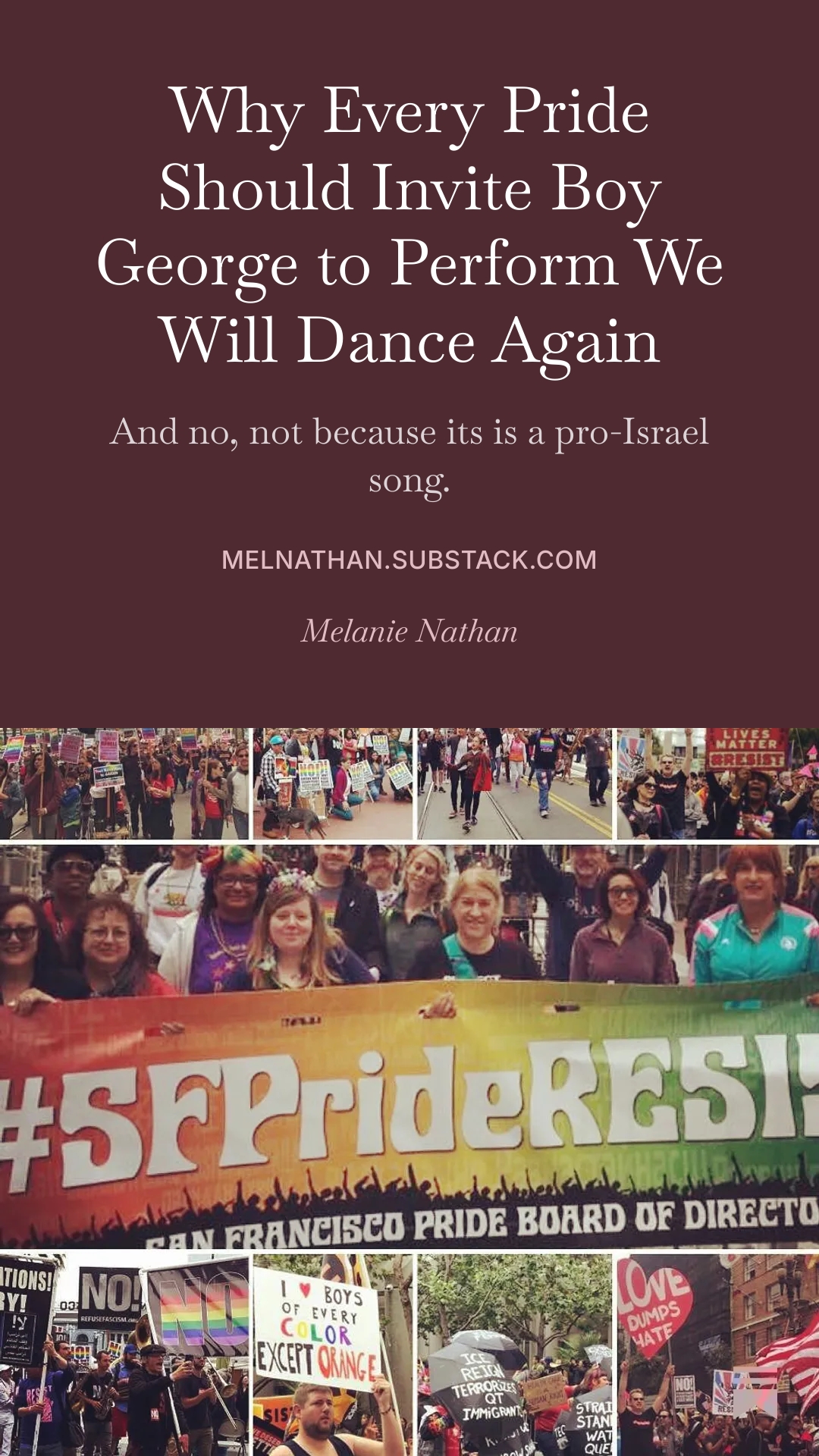
For the sake of transparency: I am a past honoree – Community Grand Marshal (2014) of San Francisco Pride. In 2015-2017 – I was elected to the Board of SF Pride and served as Vice President for a full term.

