By Melanie Nathan, July 04, 2026
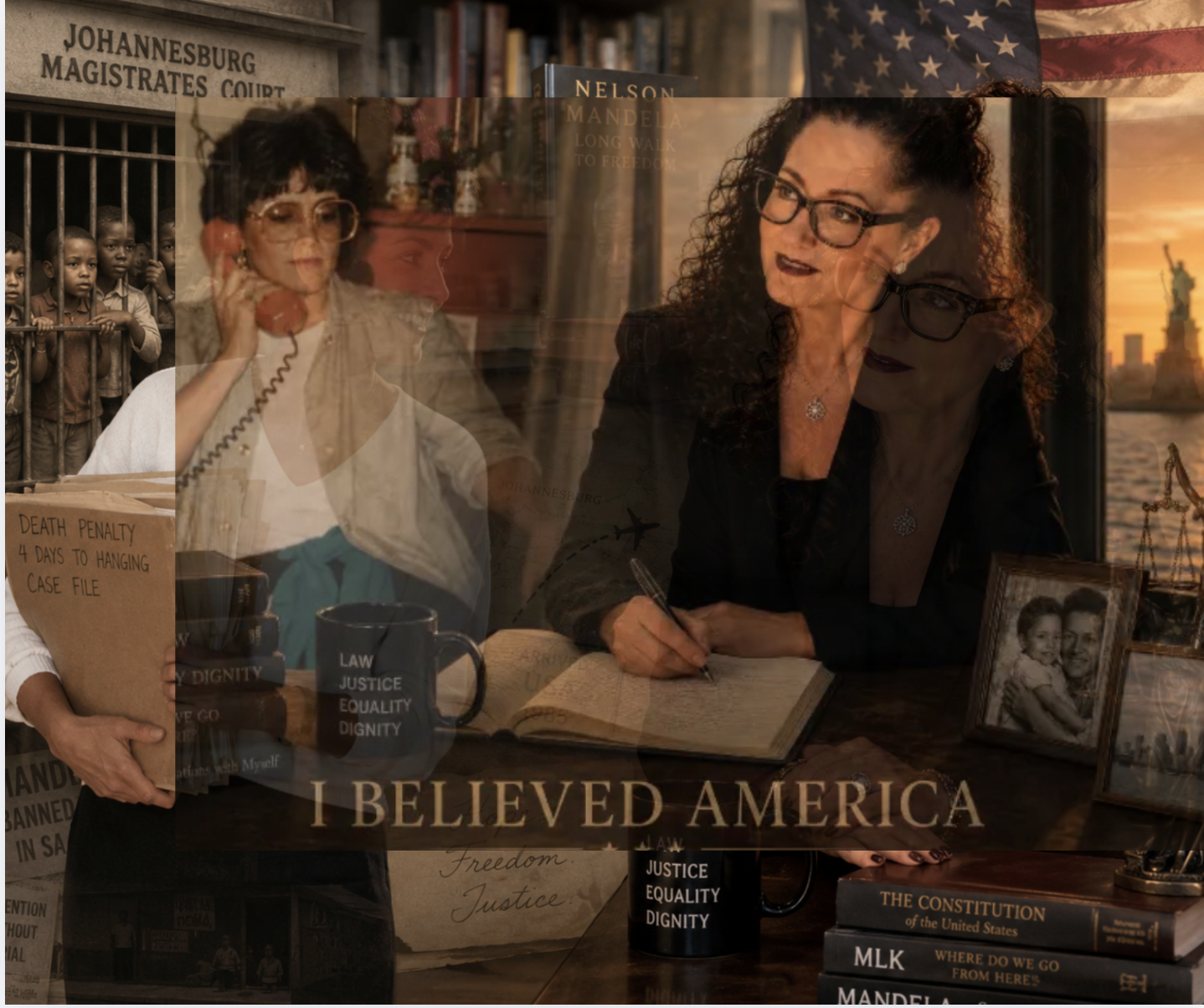
I am reflecting on America’s 250th birthday. I came here in the mid-1980s from apartheid South Africa, leaving behind my twenties and hoping for a place where law and justice might finally occupy the same room.
I had been a young, rookie attorney in Johannesburg, trying to make sense of an insanity that no law school could prepare anyone for. I found myself handling a death sentence case, the final tip to my fast-tilting world. Others had declined to take it on. I couldn’t.
The case involved 4 days to a hanging. That is when I received it. I had already seen enough to understand what apartheid did to those it oppressed, to the institutions and people it corrupted or who chose to believe it’s validity. I had seen what privilege, entitlement, and the unchecked imbalance of power could do to an entire society.
But the death sentence case was not what first opened my eyes. By then I had already witnessed countless smaller cruelties that apartheid normalized.
Some images never leave you.
Every Monday morning, children emerged from the holding cells beneath the Johannesburg Magistrates Court. Five years old. Nine years old. Twelve years old. They had been arrested because they were found on “white” streets after leaving the townships to spend secret precious hours with parents who worked there as domestic servants, gardeners, and laborers. Many of those parents did not get to return home to the villages or townships (Black designated through segregation) on weekends, so the children came to them instead, and for that, they were treated as pass law offenders.
Yet South Africa possessed one of the world’s finest legal systems. Its courts were sophisticated. Its judges, jurists, scholars and practitioners were often brilliant. Its legal profession demanded excellence.
And yet none of that could reconcile itself with the horrific laws of Apartheid – the instruments of oppression.
Day after day I witnessed a legal system capable of extraordinary precision while administering extraordinary injustice. I confronted the impossible contradiction of a country where the rule of law existed, yet justice often did not.
That case was the last straw for a young lawyer who simply could not reconcile the two, so I left. Lest I forget – of course there is so much more I could address that factors into my flight! For another day… as is that death sentence case story…
America was not simply another country. To me, it represented an intriguing idea.
It was a nation born from a declaration that liberty belonged to ordinary people rather than kings. A country that welcomed those fleeing tyranny. A constitutional republic built upon the audacious proposition that government itself should be constrained by law. I was one hundred percent sure that by now (the ‘80s) there was no racism in America and there would always be justice in every situation.
Perhaps one memory captures that feeling better than any speech ever could.
In apartheid South Africa, owning books about Nelson Mandela was not legally possible – their publication, distribution and possession were banned. You could go to jail for that. His image was also banned from press.
I walked into my first American bookstore, and sitting openly on the shelves, were books about Mandela. Not hidden. Not whispered about. Of course I purchased every Mandela title on the shelf.
Then I placed them openly on my coffee table.
It sounds almost laughably ordinary today. Especially when dad came from South Africa to visit, and suggested I hide the books in case anyone sees. I explained he had no reason to be scared – it was America.
Of course I had a lot to learn and my journey soon burst my imaginary bubble. America was imperfect and had its own injustices. But compared to what I had witnessed in my birthland, America felt revolutionary – because ideas were allowed to exist and people did not fear government in the way I knew that fear.
It was hardly perfect. But compared with the country I had left, the difference felt immeasurable.
Freedom still lived in everything just because you could fight for it. Like displaying a book without fear. Like criticizing your government without wondering who might be listening. Like believing that tomorrow could be more just than yesterday. Like knowing you would not get locked up for using your words. Like not getting shot on the streets when you demonstrate for your rights and those of the most vulnerable.
With all that hope there is no escaping the adaptation and that immigration is lonely. You leave so much behind, your rhythms, your family, friends, roots that entrench familiarity. And if you are a spoiled Jewish white girl, a hella lot more. Even more so when there is no email and no internet. Your accent becomes your introduction before your name does and four decades later, people still ask me where I am from.
I still remain, in some subtle way, the outsider. Yet I also recognize something many immigrants cannot ignore. I arrived with white skin. That privilege travelled with me, even as everything else did not. If immigration was difficult for me, I often marvel at those who arrive carrying not only an accent but racial prejudice, cultural misunderstanding, religious discrimination, language barriers, or visible difference. Their burdens are heavier than mine ever were back then.
Four decades have now passed. Enough time to look back, not only at my own journey, but at America’s on this its 250th celebration of independence.
While America experienced challenges through its history, no matter what, it still possessed something extraordinary as it always seemed to aspire upward. Progress. Sometimes it would sink very low before any signs that this aspiration had scored some points.
Its politics often lagged behind its ideals, but the ideals themselves pulled the nation forward. That is what made America exceptional. It seemed to have the capacity to correct itself.
There always seemed to be a willingness, however painfully, to become more faithful to its founding promises.
The story of immigration itself reflected that struggle. Some presidents expanded opportunity. Others narrowed it. Some welcomed newcomers. Others treated them with suspicion.
– Ronald Reagan signed the 1986 immigration reform that legalized nearly three million undocumented immigrants while simultaneously strengthening enforcement.
– George H. W. Bush signed the 1990 Immigration Act, expanding legal immigration and modernizing parts of the system.
– Then came one of the deepest personal betrayals for LGBTQ Americans: Bill Clinton signed the Defense of Marriage Act. With one stroke of a pen, the federal government declared that same-sex marriages would not exist for federal purposes. Thousands upon thousands of loving couples were separated by immigration law.
American citizens could sponsor opposite-sex foreign spouses under family petitions. Gay Americans could not. Tens of thousands of couples lived under the constant fear of separation because the person they loved had no lawful path to remain in the U.S. beside them.
For those of us in the LGBTQ community, America had welcomed us with one hand while pushing us away with the other. After years of litigation, advocacy, heartbreak, and political courage, history eventually corrected that injustice.
Presidents evolved. The courts evolved. The country evolved. That was, perhaps, America’s greatest strength. It could admit it had been wrong. (Of course I am leaving a lot out)
Which brings me to today.
Today, it feels as if something different is happening. The word ‘evolve’ is being hauled off in chains, screaming from its lexicon, replaced by ‘devolve.’
What ought to be a reasonable debate about improving immigration policy, noting every sovereign nation has both the right and the responsibility to secure its borders, has turned into – let me blunt – a shit show when it comes to the annihilation of decades of consistent policy, international obligations, rights and freedoms.
And I am only talking about immigration – where there is so much more.
Reasonable people can disagree about visa programs, asylum standards, refugee numbers, detention practices, or enforcement priorities and look for solutions. That is democracy.
That is not what we have seen in the past 18 months.
Instead a contemptuous replacement of welcoming the stranger has been replaced by fearing the stranger. All couched in extensive assaults on our voting rights, our checks and balances and our democracy as we have known it. The aspiration I spoke of earlier, does not seem to be a functioning concern of this republican majority Congress. They are visibly absent and complicit in a horror I am seeing. Echoes that remind me of some of the worst aspects of the country I left.
The idea that immigrants are no longer viewed primarily as future Americans but as permanent suspects.
The politics increasingly demand that society see immigrants through the lens of threat rather than possibility.
As someone who came here believing in America’s promise, that shift is ominous. It even threatens me, my children, and my community, 40 years later. The peace I came here searching for. The respite I thought I had finally found. The life I spent four decades building. The human and civil rights I have participated in fighting for.
I do not have the peace, respite and all I accomplished anymore… it is gone.
On this 250th anniversary, I grieve for the America of 1985. I mourn the promise of 1776.
I mourn because I fear America is forgetting why generations crossed oceans to reach her shores in the first place. They did not come because America was easy. They came because America was hopeful.
Freedom? Constitution? Democracy? What is this independence worth to the less powerful and the growing poor and disenfranchised class?
Yet, I still believe America can recover that promise. Experiments do not fail because they encounter hardship. They fail only when people stop believing the experiment is worth pursuing.
Do not let anyone convince you otherwise: America’s greatest inheritance has never been its wealth or its military: It has been its PEOPLE through its capacity to welcome the stranger, protect the dissenter, expand liberty, and continually bend itself toward justice.
As this nation turns 250, my greatest hope is that it remembers the country I came searching for all those years ago.
Because that America is still worth fighting for.
Melanie Nathan
Contact: commissionermnathan@gmail.com
Speaker Webpage: Melnathan.com
AHRC Webpage: AfricanHRC.org


Beautiful essay, Mel!! Perfect for the reality we are collectively going through.
Even though I am a citizen (by imposition since 1917) I’ve felt secure … I feel with the immigrants. Some are my own ‘blood’ — Latinos. I’m not forgetting the others. I’m ‘mulato’ … I have that bloodline.
My demographics could be suspect: Hispanic, senior citizen, retired, educated, married legally, proud LGBTQ … I could be found very easily.
To me the promise of the USA, ingrained since childhood … is sadly fading.
I’m glad I’m 76 now … and wonder what I will see in this uncertain future … hugs!! 🤗