A Memorial and a Mirror
By Melanie Nathan, Aug 02, 2026.
On June 27, 1976, four terrorists hijacked Air France Flight 139.
Two were members of the Popular Front for the Liberation of Palestine. Two were German militants from the Revolutionary Cells. After diverting the aircraft through Libya, they landed at Entebbe Airport in Uganda, where they found an enthusiastic ally in the murderous dictator, Idi Amin.
Inside that old terminal, history took a chilling turn. The terrorists separated the Israeli and Jewish passengers from the others, recalling the selections that had become among the defining horrors of the Holocaust.
Uganda’s soldiers guarded the terminal while the hostages remained captive, trapped between terrorist fanaticism and the calculated cruelty of Idi Amin.
What followed changed history.
On the night of July 4, Israeli commandos flew more than 2,500 miles into hostile territory in one of the most daring hostage rescue missions ever undertaken. More than one hundred hostages were rescued. The hijackers were killed. Ugandan fighter jets were destroyed to prevent pursuit.
One Israeli soldier did not return home. Hostages died.*
Lieutenant Colonel Yoni Netanyahu, commander of the assault, was fatally wounded while leading the rescue.
Nearly fifty years later, his name still symbolizes courage, sacrifice, and a nation’s determination never to abandon its people.
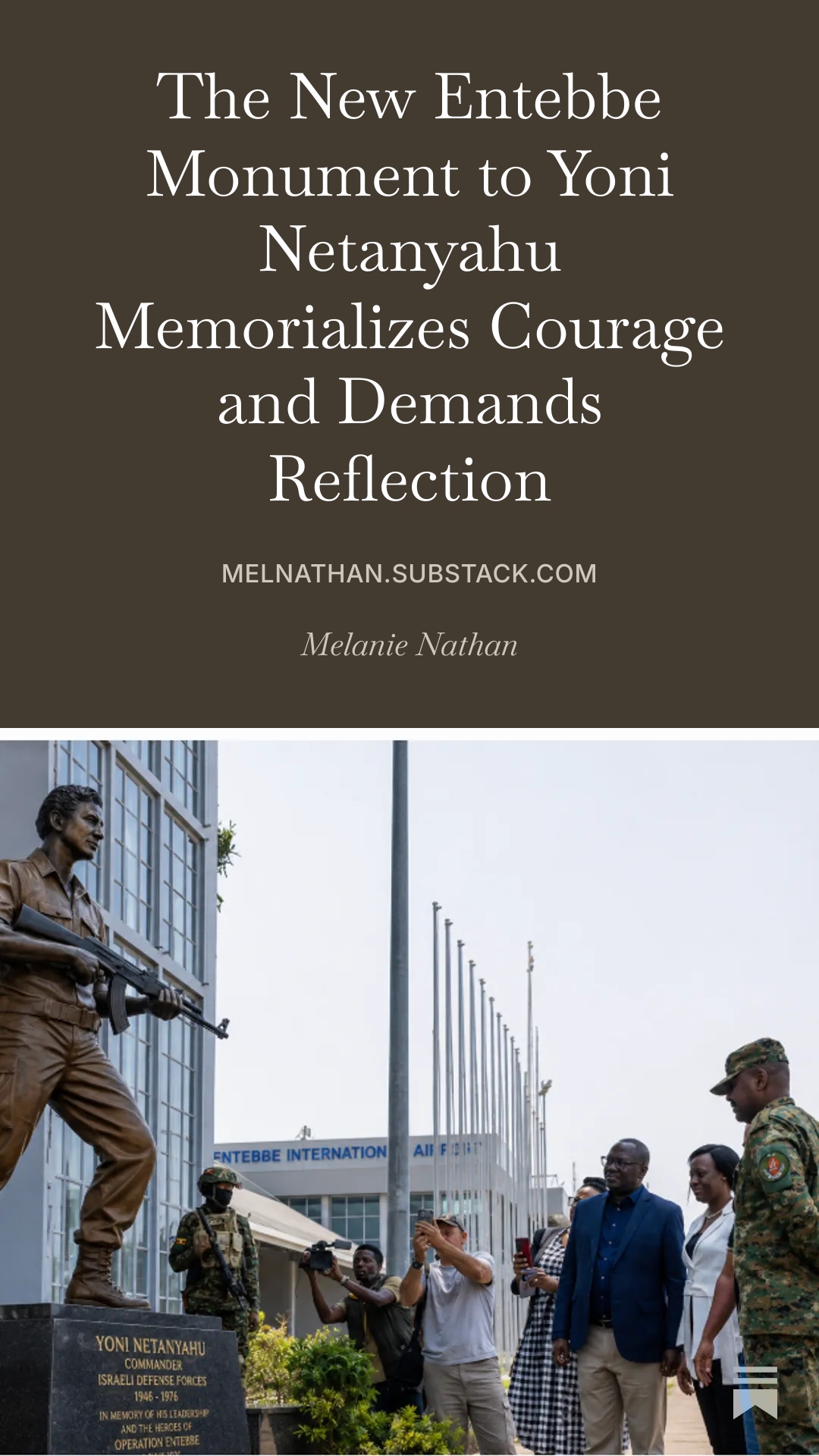 A Monument in Entebbe
Today, at Entebbe Airport, Uganda unveiled a new monument celebrating Yoni Netanyahu. The very place where terrorists once held innocent civilians, now bears a permanent tribute to the man who led their rescue.
The events at Entebbe left an indelible mark not only on Israel, but on the Jewish people and on the Netanyahu family itself. They reinforced a national ethos that no Israeli should ever be abandoned to terrorism, wherever they may be. For Israel the loss of Yoni was a national tragedy and for Benjamin Netanyahu, the loss of his older brother was a deeply personal one that has undoubtedly shaped his understanding of leadership, security, hostages and Israel’s commitment to the Jewish people.
Nearly five decades later, the barbaric Hamas massacre of October 7, 2023, with the abduction of approximately 250 people into Gaza, struck at the very heart of that ethos. Whether one supports or opposes Israel’s subsequent military campaign in Gaza, it is impossible to understand the country’s response without understanding Entebbe.
Operation Entebbe was more than a military success. It became a national promise that Israel would go to extraordinary lengths to bring its people home. On October 7th, the terrorists knew this! Their decision to take that many innocent civilians spanning – baby to elderly, male to female, – and with the accompanying cruelty, was a calculated call to the martyrdom they openly recorded, publicized, and cherished – all translating to an obvious tactic, the orchestrated civilian sacrifice – even of their own Palestinians in Gaza. They knew who was at helm, and they knew the response!
More Than History
Now the monument to his brother is more than a memorial. It is an indictment. An indictment of terrorism. An indictment of hostage taking. An indictment of those governments that enable, fund, or shelter terrorists, and all who prop it up.
Entebbe reminds us that terrorism is not resistance. It is never merely an act of violence. The platforms that enable it depend upon those willing to justify it, facilitate it, or provide it with sanctuary.
That lesson has not grown old. It remains painfully relevant.
When Hamas crossed into Israel on October 7, murdering, maiming, raping, mutilating civilians, and abducting approximately 250 people, they also attacked one of the deepest covenants between the State of Israel and its people: The promise that Israel will go to the ultimate length to “bring them home.”
Now woven into Israel’s national identity, Entebbe helped define that promise almost fifty years earlier. The world saw a nation willing to cross continents to rescue innocent Jews.
Uganda’s Other Story
Yet there is another reason this monument matters. People who follow Israel may now find themselves looking more closely at Uganda. They should. Because Uganda’s story did not end with Idi Amin.
For nearly four decades, President Yoweri Museveni has ruled Uganda. What began with promises of liberation and democratic renewal has steadily given way to political repression, shrinking civic space, and the persecution of dissent.
An aging Dr. Kizza Besigye, one of Uganda’s most prominent presidential election opposition figures, remains imprisoned on trumped up treason charges, despite being in ICU after a collapse in a Ugandan court this past week.
Bobi Wine, a former MP and recent presidential candidate, has repeatedly faced arrests, violence, and intimidation in his attempts to stand for office.
Journalists continue to suffer persecution for honest reporting, several sought asylum abroad. Civil society faces increasing restrictions. LGBTQI Ugandans endure some of the harshest persecution on the African continent, with the recent signing by Museveni of what has become known as “The Kill the Gays Bill,” an anti-homosexuality act that carries life in prison for consensual same-sex relations, and the death penalty for so called “aggravated homosexuality.”
These stories remain buried, even by the Mayor of New York City Zohran Mamdani, who while holding dual citizenship to include the land of his birth, Uganda, seems hellbent on his selective performances when it comes to casting light on foreign leaders.
Looking Beyond Israel
There is an irony here. A monument honoring one of Israel’s greatest military heroes may cause many people to pay attention to Uganda for the first time. If that happens, I hope they do not stop with the story of Entebbe. I hope they ask what freedom looks like in Uganda today. I hope they learn about the violent crackdowns on political opposition, about those imprisoned for opposing the government. I hope they hear the voices of LGBTQI+ Ugandans, living in hiding, and fleeing the persecution and violence. I hope they understand that the struggle against oppression in Uganda did not end in 1976. The post Amin struggle simply changed form.
I hope they also look beyond the selectiveness that recently has shaped global outrage. Beyond the silence that greets some, while others command endless attention. Beyond the political calculations and opportunism of leaders, and the weaponization of fashionable causes by protesters, and the unequal spotlight cast by much of the world’s media.
Uganda must be seen not only when Israel enters the story. Its political prisoners, its persecuted minorities, and its people yearning for freedom ought to matter on their own.
This paragraph can scarcely capture the thoughts it stirs within me. It merely scratches the surface of a much larger conversation about moral consistency, selective conscience, and the obligation to care about injustice wherever it occurs. There is a danger in allowing our compassion and attention to become selective. When human rights become fashionable in one place and invisible in another, they cease to be universal. They become political. There are only so many hours in a day, so many headlines, so much public energy, and so much political will. When an overwhelming share of that attention is directed toward one conflict, people suffering elsewhere inevitably receive less of all of it. They become less visible, less advocated for, and less protected. The universality of human rights is diminished not because those rights disappear, but because our willingness to defend them becomes selective.
Human rights lose their universality when our concern is measured by the popularity of the cause.
The Reflection
The Yoni Netanyahu monument reminds us of extraordinary courage. It reminds us that terrorism should never be romanticized. It reminds us that democracies have both the right and the obligation to defend innocent lives. Perhaps it can do something else …. more …
Perhaps it can encourage those who came looking at Israel to also look at Uganda and beyond. Because history does not belong only to those we memorialize. It also belongs to those still waiting for the freedoms they were promised. Bronze remembers. The question is whether we will and how we will honor such memory.
*IN MEMORY OF THE HOSTAGES WHO DIED IN ENTEBBE:
Dora Bloch, Jean-Jaques Maimoni, Pasco Cohen, Ida Borochovitch
May their memories be a blessing.

By Melanie Nathan
Executive Director
African Human Rights Coalition
Country Conditions Expert, Uganda.
Substack: melnathan.substack.com
Speaking: melnathan.com
 O-blog-dee-o-blog-da