By Melanie Nathan, June 15, 2026.
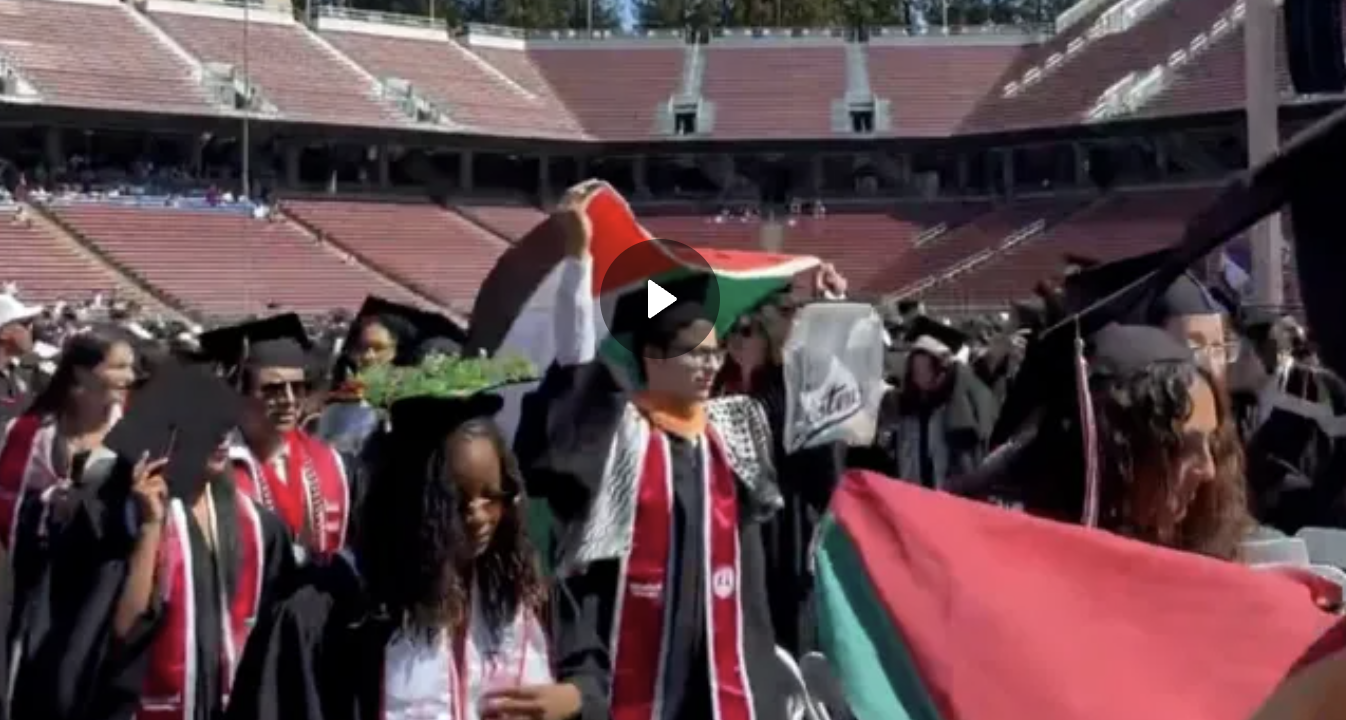 I just watched a video of American students walking out of Stanford University’s commencement ceremony, waving Palestinian flags as they exited. For many, the flag symbolizes solidarity with Palestinians in Gaza, resistance, or opposition to Israeli government policies. For many others and Jews, the Palestinian flag no longer appears in a political vacuum. Since October 7, it has frequently been displayed at demonstrations where Hamas atrocities were minimized, rationalized, omitted altogether, or where protestors have called for the extinction of Jews. Whether intended or not, the association has profoundly altered how many Jews experience the symbol.
The headlines have been: Hundreds of Stanford students, led by Stanford Students for Justice in Palestine, walked out of Google CEO Sundar Pichai’s commencement: It got me reflecting ….
Every generation of students inherits a test. In the 1960s, American students sat in, marched, registered voters, challenged segregation, demanded free speech, and resisted the Vietnam War. In 1970, after the war expanded into Cambodia, student protest spread across the country; at Kent State, four students were killed by the National Guard. In South Africa, the children of Soweto walked out in 1976 against apartheid education, and some paid with their lives.
The significance of these movements was not that students cared about distant suffering less than local injustice. It was that they recognized a distinct responsibility to confront the defining challenges and abhorrences facing their own society. Their activism was rooted in civic engagement. Their activism was an attempt to influence the course of their nation. They answered the call to a generational responsibility.
Student protest has never been perfect. It has often been messy, naïve, self-righteous, and disruptive. But at its best, it has also been a moral alarm bell. It has said: something is wrong here, in our country, in our institutions, in our name.
Since October 7, 2023, the loudest and most visible student movement in America has centered overwhelmingly on Israel and Gaza. While some may argue that Palestinian suffering is real, and criticism of the Israeli government is legitimate, what has been so morally jarring is the selectivity. The absence of a comparable student movement for the Jews massacred, raped, kidnapped, held hostage by Hamas; the use of Palestinians as human shields, the casual demonization of Israel; the ease with which antizionism has usurped a landscape shrouded in myth, libel and myopia, may be shocking – yet even that is eclipsed by the elephant in the room:
And now, while American democracy itself is under attack, where is the great student uprising?
 The ineptitude, and the apparent unavailability of this graduating generation is especially perplexing, as rarely in modern American history have democratic and judicial institutions faced such sustained attack by such an overtly corrupt regime rooted in a trajectory of increasing authoritarianism. All in plain sight, with devastating consequences – such as babies held in detention – and American protesters killed on our streets.
Where are the sustained campus protests against authoritarianism, attacks on courts, attacks on universities, attacks on immigrants, attacks on civil rights, attacks on voting rights, attacks on LGBTQ people, attacks on reproductive health, attacks on the press, attacks on truth itself? Where is the generational fury against MAGA’s assault on democratic institutions? Where are the student walkouts for America’s own collapsing constitutional order? Where, Where, Where?
This is the question that must be asked: why does one small country thousands of miles away command such consuming student rage, while the erosion of democracy under their own feet produces nothing remotely comparable?
One need not overstate the answer. But one cannot ignore the possibility that something darker is at work: not merely compassion for Palestinians, but a moral imagination in which Jewish self determination is uniquely disparaged and vilified. Jewish self-defense uniquely unforgivable, and Israel uniquely worthy of selective obsession.
The students of Soweto walked out against apartheid in their own country. They faced the regime that governed them. They confronted the system that shaped their schools, their lives, their future. That is what makes their courage so haunting and significant even to this day.
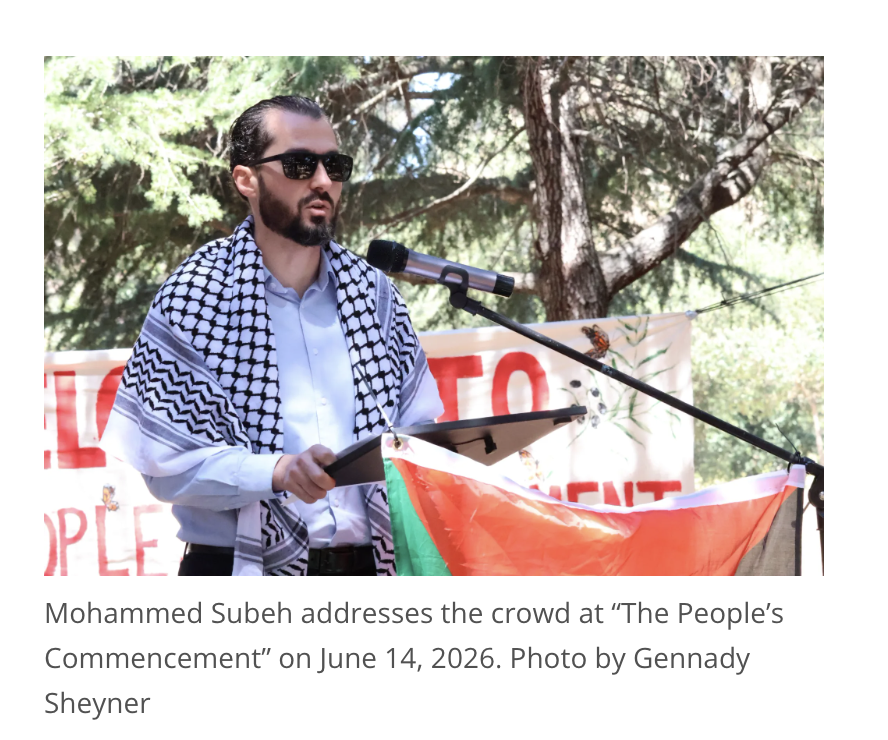 American students invoke apartheid with such ease, but too many have failed to confront the danger rising inside their own democracy.
It is fair to ask how a generation that has shown such extraordinary energy and commitment on one issue has remained comparatively absent from the struggle to defend democratic institutions at home. Have students been distracted, persuaded, or even manipulated into treating one conflict as the defining moral cause of their age while neglecting the freedoms upon which all causes ultimately depend?
In this moment, as America’s democratic foundations are crumbling, students have followed a road that points its way far from home. They have failed to notice the ground shifting beneath their own feet. Instead of marching toward tyranny, of standing in its way, they are seen to be running away. And that is how democracies are lost.
I am sure this invokes much more than I can address here…. there are many questions …
Let me be clear: asking this question is not to suggest that students cannot care about multiple causes at once, nor that suffering abroad is somehow less worthy of concern than suffering at home. Students have always looked beyond borders, and rightly so.
But when one of the most consequential challenges to democratic institutions in generations unfolds within their own society, while the overwhelming energy of campus activism is directed elsewhere, the contrast becomes impossible to ignore. It is not the presence of concern for Gaza that stands out. It is the absence of comparable urgency for the preservation of the democratic principles upon which all protest, dissent, and activism ultimately depend.
That disparity glares. And it is a question this generation should be willing to answer.

