What the Greatest Rugby Rivalry Can Teach the World
By Melanie Nathan, Sep 15, 2026
For a few extraordinary hours in Baltimore, we knew exactly why we were there and who we were. We had all traveled from afar to watch a rugby match. Not just any rugby match, but South Africa against New Zealand: the Springboks, the Bokke, against the All Blacks, the final Test of what had appropriately been billed as Rugby’s Greatest Rivalry.
But somewhere amid the green and gold, the flags, the anthems, the rivalry and the roar of more than 68,000 people, something happened that I had not expected. A crowd drawn from different races, religions, languages, histories, politics and generations found an extraordinary unity without requiring anyone to surrender those differences. And our fierce rivalry with New Zealand managed to remain exactly that a rivalry harboring a unity not hate.
I went to Baltimore to watch rugby. I came away thinking about something much larger: what happens when people know who they are, find common purpose in what they share, and still leave room for others to be equally certain of who they are. At a time when so much of the world seems to confuse disagreement with enmity, identity with exclusion, and opposition with hate, perhaps the greatest rivalry in rugby has something rather important to teach us.
There was no ambiguity about our loyalties. Together with the many thousands of people around me, all dressed in green and gold, I wanted the Springboks to win. The New Zealanders dressed in black wanted the opposite. And somehow, instead of differences destroying the epic experience, the differences between ourselves- the fans – and team vs. team, – created a deeply meaningful and memorable experience.
We Came From Everywhere
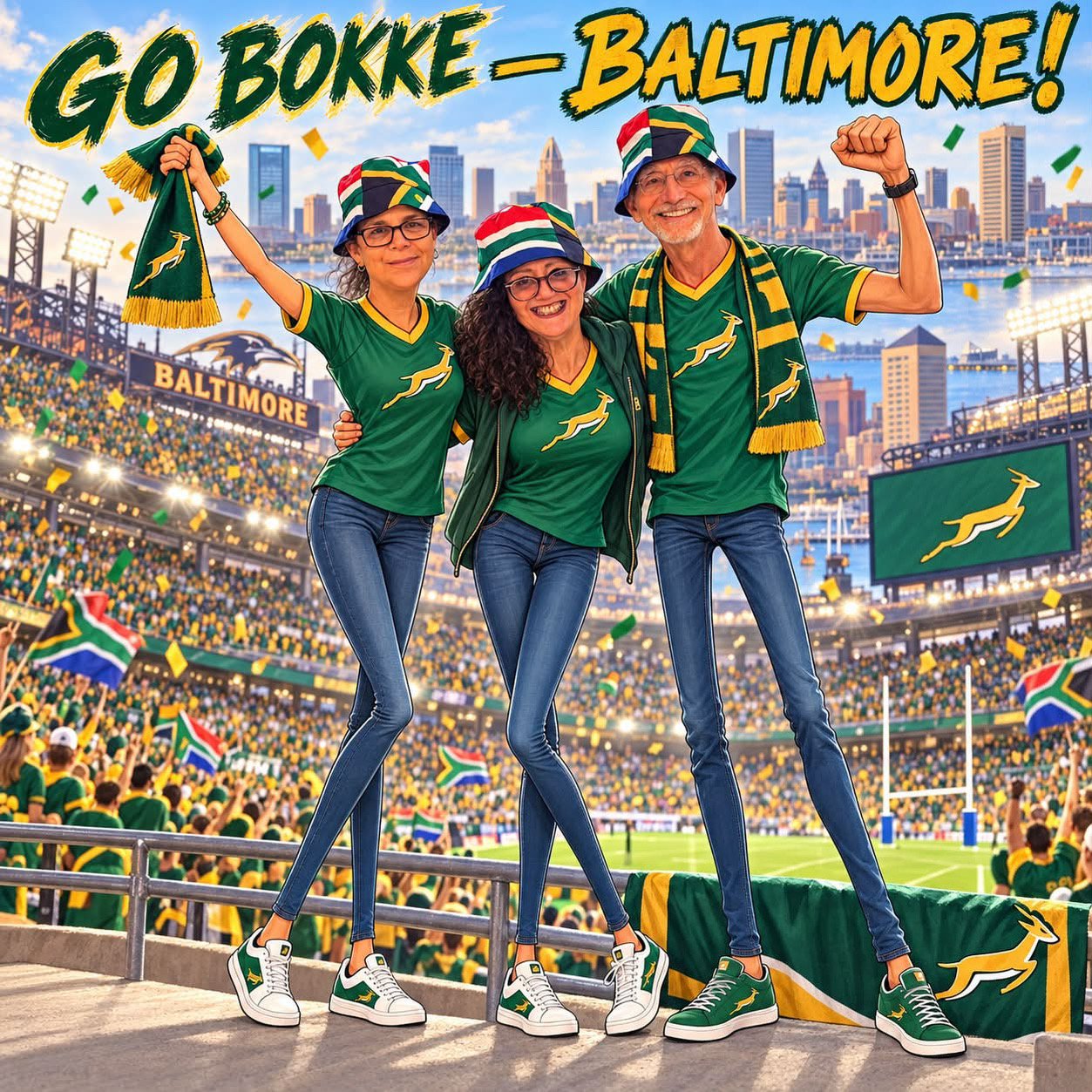
South Africans descended on Baltimore from across the United States and from around the world. Some were recent immigrants. Others had lived outside South Africa for decades. Some still carried South African passports. Some were dual citizens. Others, like me, had long ago surrendered the formal documentation connecting us to the country of our birth.
In the months, weeks and especially the days ahead of the match, social media lit up with advice, tips, resources, merch, and awe-inspiring stories of the journeys people were undertaking. Then came the photos and reports in real time as momentum built on our way to Baltimore. Many traveled extraordinary distances, like the mother and daughter driving from Houston, or the family of six from Toronto. Others flew across the United States or crossed oceans. Families came. Children came. Office buddies. American spouses about to experience a tailgate like no other. People spent money they could barely afford on airfare, hotels and tickets. And with all of this none of us realized just how epic an experience we were about to have.
Wading our way through parking lots filled with braais and boerewors, and clusters chanting the iconic Shoshaloza, we made it to the stadium and it felt like home.
By the time the teams walked onto the field at M&T Bank Stadium on September 12, 68,173 people had gathered, the largest crowd ever recorded for a rugby match in North American history. Fans had bought tickets from all 50 American states and more than 30 countries.
And there was still quite a story about to unfold…
Through the pre-ceding weeks in this test series, New Zealand had struck first, beating South Africa 33–16 at Ellis Park in Johannesburg. The Springboks answered in Cape Town, winning 33–26. Then came Soweto, where South Africa prevailed 29–24 before nearly 86,000 spectators. So South Africa was leading the four-Test series 2–1. This game was anyone’s victory. The All Blacks could level it or the Springboks could claim it.
Eighty minutes later, South Africa had won 43–28 and taken the series 3–1. But strangely, even amidst the glory, the score is not what I have thought about most since coming home.
The Rainbow Nation, Thousands of Miles From Home
South Africans have called ourselves the Rainbow Nation for decades. Sometimes the expression can sound sentimental, particularly when measured against the country’s enormous continuing problems. But stand among tens of thousands of South Africans thousands of miles from South Africa and suddenly you understand what the expression is trying to describe.
Under the old Apartheid laws we received the Nationalist government’s racial classification as Black, White, Coloured and Indian. We are still those same people no longer separated by force but government by democracy. We are every religion. We come from different cultures and different histories. We speak different languages. We have different politics. We have radically different experiences of the country we call home or once called home.
South Africa’s Constitution expresses the aspiration beautifully: South Africa belongs to all who live in it, “united in our diversity.”
In Baltimore, for a few hours, I could feel what those words mean. I wrote on Facebook afterwards: “I had a deep need to connect with the land of my birth. It was epic. After decades, I felt so complete in my love for the Rainbow Nation and its extraordinary people…”
That is what happened to me there. There are almost no words to explain being surrounded by 68,000 people, so many of whom shared a depth of understanding that is particular to the place from which we came.
And with all those difference we first sang the American national anthem and then the South African national anthem: The anthem itself tells our story. It incorporates five languages, isiXhosa, isiZulu, Sesotho, Afrikaans and Englis, and does something even more extraordinary – it combines Nkosi Sikelel’ iAfrika, once sung in defiance of apartheid, with Die Stem, the anthem associated with the country that preceded our democracy, that once oppressed.*
Think about the audacity of that. We did not construct unity by pretending the past had never happened. We built an anthem that carries pieces of competing histories inside it. And tens of thousands of us – mostly expats- stood in an American football stadium and sang it together, bound by our history, our past, our diversity and our differences.

Loving a Country Does Not Require Silence
My relationship with South Africa is not uncomplicated. Anyone who has read my work knows that. I left the country in 1985 – during the height of Apartheid, before Nelson Mandela was released. Before the new Democracy. I have criticized the ANC- South African government. I have criticized policies and political decisions. I have written about failures that anger and disappoint me deeply.
More recently, I have been especially critical of South Africa’s xenophobic movements targeting fellow Africans, and also the way the Trump administration’s refugee policies have created preferential pathways for some South Africans while shutting down or severely restricting pathways for refugees from elsewhere, including people facing grave persecution from other African countries. My objection has never required resentment toward individual South Africans who were offered protection. My anger is directed at a system that, in my view, has treated human vulnerability unequally.
None of my criticism diminishes my love for South Africa and the people of the country where I was born. In many ways, the criticism exists because of the love.
I want South Africa to succeed. I want the promises of its Constitution fulfilled. I want the Rainbow Nation to be more than a beautiful expression remembered from the Mandela years.
South Africa also gave refuge to my family. My grandparents came there fleeing the persecution of the Pogroms. South Africa became the place where subsequent generations of my family were given life!
Then Came the Haka
And this may have been the most important moment of all. We wanted to beat New Zealand. This rivalry is more than a century old. South Africa and New Zealand have spent generations measuring themselves against one another on rugby fields. But before we could oppose the All Blacks, they presented something of themselves. The haka…
Haka is not a sporting gimmick created for television. It is a living expression of Māori culture, of identity, heritage, pride, unity and mana. Haka can serve different purposes in Māori life, including welcome, commemoration, celebration and challenge. It has been part of New Zealand rugby for more than 130 years.
Pic: The Haka : Photo: Melanie Nathan
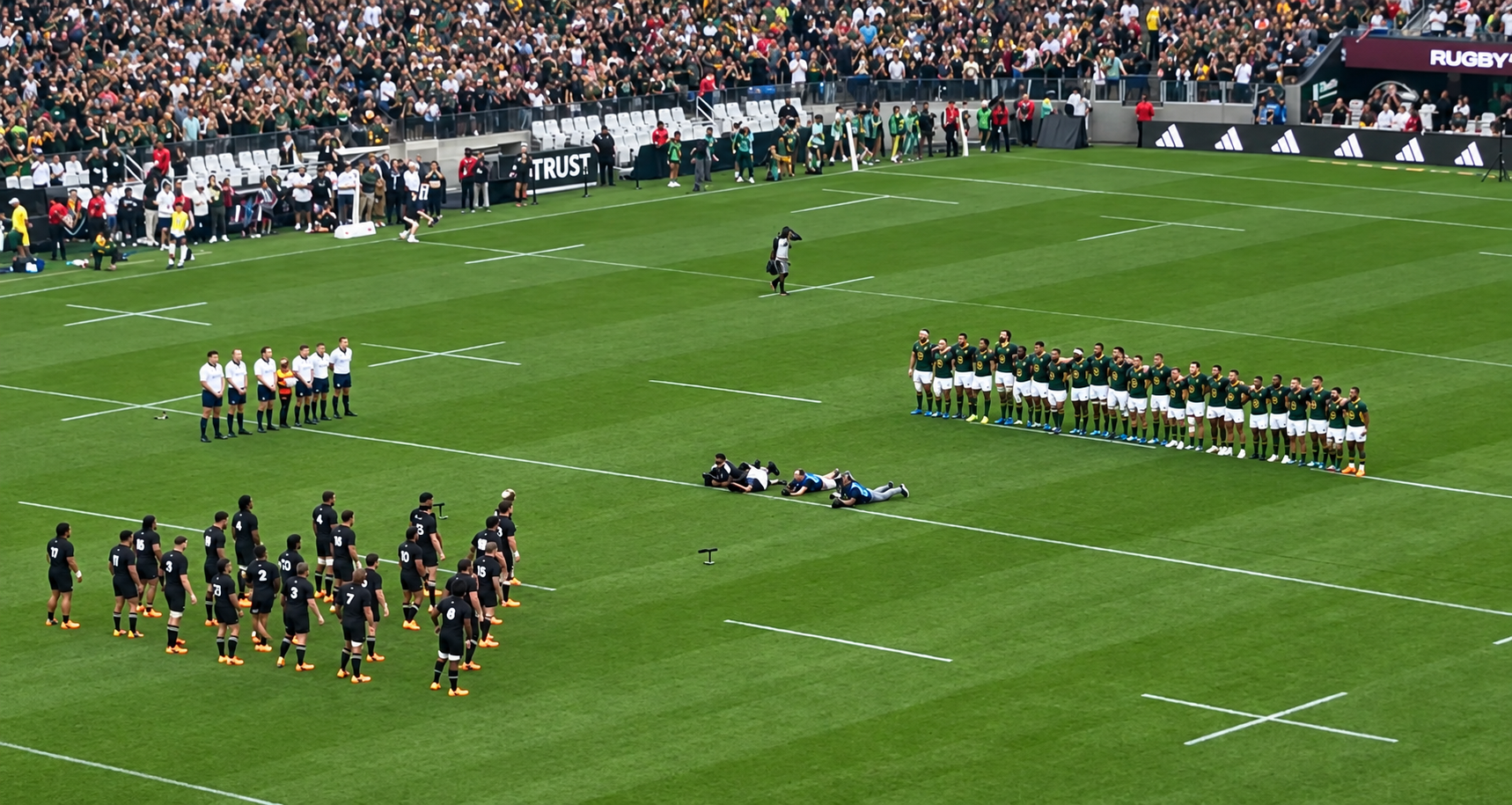
And there, in Baltimore, the All Blacks stood before all of us, and with the Springboks lined up to receive the Haka directly in front of them. For a few moments, a stadium that had been exploding with noise became respectfully silent.
The tens of thousands understood they did not have to be New Zealanders to understand that what was being offered deserved something beyond ordinary respect. We did not have to surrender our Springbok jerseys. We did not have to pretend that we wanted the All Blacks to win. We did not have to adopt Māori culture as our own. We simply had to recognize that this moment was theirs. There was no mockery, no ridicule, no attempt to diminish what it meant. The All Blacks delivered the haka with its full force, pride and determination; their rivals received it with the solemnity due to something culturally sacred, not in submission, but in acknowledgment. It was an extraordinary exchange: one side asserting who they were, and the other honoring their right to be exactly that.
Then the haka ended.
And we could roar for the Bokke again.
There Is a Lesson in That
Somewhere along the way, much of our world seems to have forgotten the difference between opposing somebody and erasing them. We increasingly demand ideological purity as the price of belonging. We sort human beings into camps. If you disagree with me, you must be immoral. If I condemn something your government does, I must hate your country. If I love my country, I must defend everything its government does. If your history conflicts with mine, one of our histories must disappear. If your symbols matter to you, I must either adopt them or destroy them. But sport, at its best, teaches something considerably more sophisticated.
You can oppose without dehumanizing. You can compete without erasing. You can challenge without despising. You can love your own without demanding that somebody else stop loving theirs. And perhaps most importantly: You can respect the haka and still desperately want to beat the All Blacks. There is no contradiction.
In fact, the respect makes the rivalry greater.
Common Purpose Does Not Require Sameness
Something else happened in Baltimore. Tens of thousands of South Africans who might disagree profoundly about politics, religion, history, race, Iran, Israel, Gaza, South Sudan, immigration, economics, the ANC, the United States, Donald Trump, or almost anything else did not interrogate one another before standing together. They did not bring flags that would offend. They waved one flag for each team. That was it. No tropes. No violent chants.
Nobody at the stadium entrance handed us an ideological questionnaire. Nobody asked which South Africa we remembered. Nobody asked how long we had been gone. Nobody demanded proof that we had suffered enough, protested enough, voted correctly or interpreted history identically. We had a common purpose. For those hours, it was enough.
And something else was striking for what was not there. There were no displays of hate. No need to announce contempt for another people in order to demonstrate love for our own. No symbols intended to provoke or humiliate. No demand that someone else’s identity be diminished so that ours could be elevated. Even in one of the fiercest rivalries in world sport, rivalry did not require hatred. And no one coopted the moment opportunistically for their propaganda or political purpose.
That does not mean our differences disappeared. It means our differences did not have to disappear for our commonality to matter and our commonality did not require an enemy to hate.
That distinction feels increasingly precious. The great mistake we make when talking about unity is imagining that unity requires agreement. It does not. Unity requires finding something important enough that people who disagree can nevertheless stand beside one another, while recognizing that disagreement need not descend into contempt.
Perhaps that is the distinction we are losing: we can stand fiercely for what is ours without standing against the humanity, dignity or identity of someone else.
South Africans understand something about this, perhaps because we have had no choice. We come from a country whose modern democratic experiment required people carrying profoundly different histories and good reason to resent, to attempt to build one future.
While we have failed at important parts of it, overall many successes are there. We continue to struggle enormously. But sometimes, 8,000 miles from home, you get a glimpse of the possibility again.
Respecting the Haka
My brother Steve, a Springbok himself,* gave me this experience for a very big birthday. He could not possibly have known what he was really giving me. It was not simply a ticket to a rugby match. It was a reconnection with something I had perhaps not realized I needed quite so badly.
I watched the Springboks beat the All Blacks. I sang an anthem composed from languages and histories that once stood on opposite sides of an almost impossible divide. I stood among people who looked nothing alike and yet understood something about one another – feeling deeply connected- before we had exchanged a word. And I watched our greatest rivals perform the haka. We respected it. Then we competed.
Then one side won and the other lost.
And when that happened we witnessed something so moving there was not a dry eye- the Springboks and the All Blacks formed a circle. They stood among each other, one Springbok next to one All Black and then got down on their knees and prayed, giving thanks, together.
Pic; After the game, side by side for prayer of thanks. Photo: Melanie Nathan
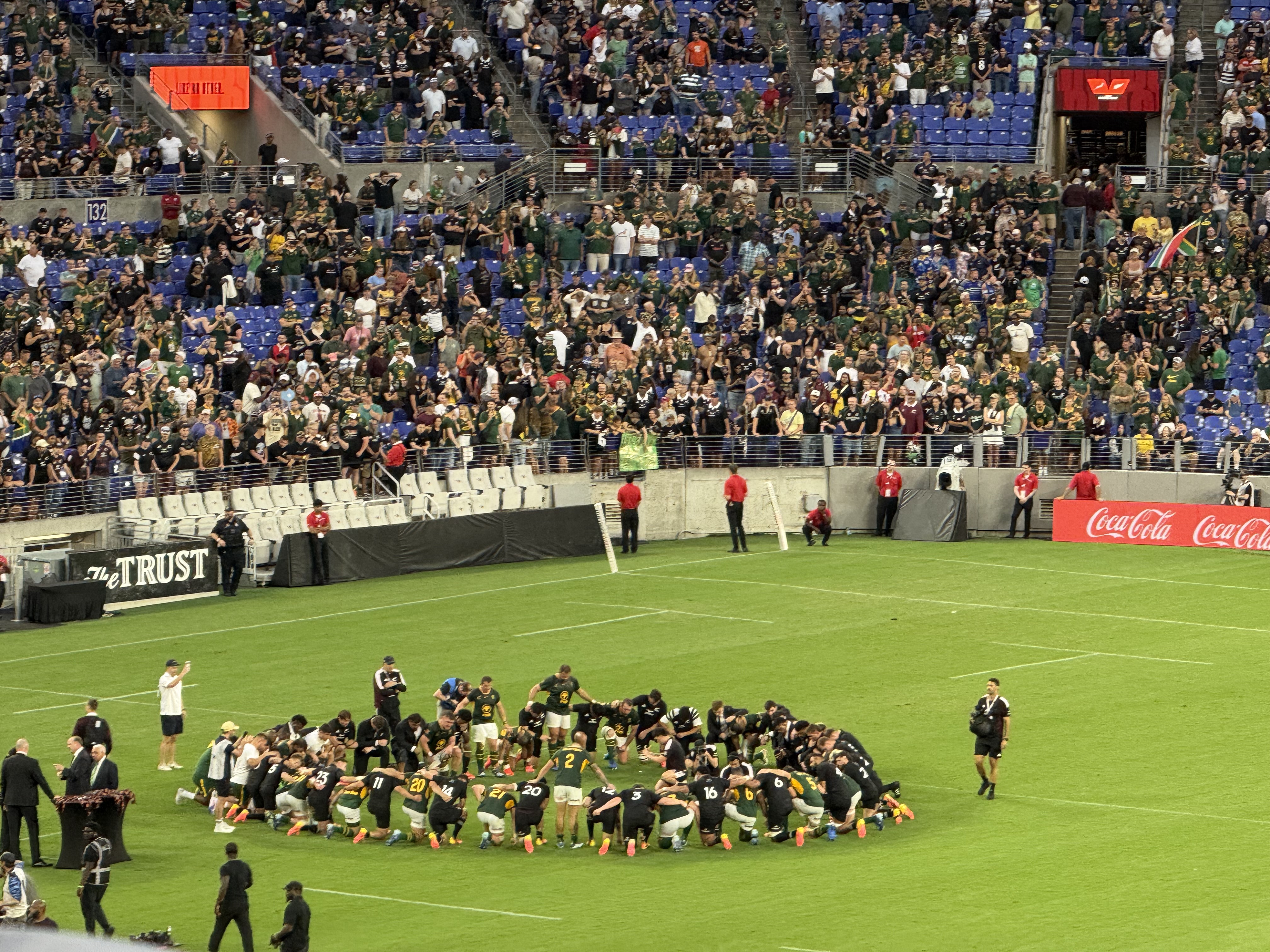
Nobody needed the All Blacks to stop being New Zealanders for us to celebrate being South African. Nobody needed Māori culture diminished for Springbok culture to flourish. Their pride did not subtract from ours. Their identity did not threaten ours. Their history did not erase ours. And we South Africans accomplished this union from a place of so many differences. The unity in our commonality and differences was awe inspiring,
Perhaps that is what the greatest rivalry in rugby can teach a world increasingly incapable of disagreement without destruction:
Know who you are. Love what is yours. Stand beside people who are different from you when you discover what you share. Fight fiercely for what you believe in.
And when someone standing across from you tells you who they are – allow it – it does not diminish you – we can all respect the haka.
*This the Experience – “Nkosi Sikele iAfrica” here
———————————-
Author’s Note:
A great big thank you to Siya Kolisi, Coach Russ Erasmus, the entire team of Springboks for leading the way, the game, the hard work and for your appreciation of what we all accomplished last week here in Baltimore. None of this could have happened without the Springboks.
A huge thanks to my boet, Steve, for this amazing birthday present, the perfect tribute to my many decades. Steve is also a Springbok! A great accomplishment. He attained his Springbok colors in the late 70’s in South Africa as a Swimmer, once holding the record for the ‘fastest man in the water in Africa’. At the time South Africa was banned from the Olympic due to Apartheid.
Thanks for reading! Free to Subscribe
*This an Experience – “Nkosi Sikele iAfrica” here
First Published on my Substack here

