 Imagine you are nineteen years old. You arrive at college politically aware but hardly an expert on the Middle East. You know there is an Israeli-Palestinian conflict. You have heard about Gaza and the West Bank. Perhaps you know something about October 7. Perhaps you know almost nothing about Zionism beyond what has appeared in your social-media feed. You may even have absorbed the sense that Zionism is a bad word, simply because that is how it has repeatedly crossed your screen. But you have never really stopped to examine what it means, where it came from, or why it matters so profoundly to so many Jews. And now you are embarking on this fabulous new journey: university, that great bastion of knowledge, inquiry, challenge and discovery.
And then the vocabulary starts arriving, not necessarily in a textbook, and not always as an argument you are invited to interrogate. It is on the signs taped to walls and carried across the quad. It is in chants at rallies. It is projected onto lecture-hall screens. It appears in student-group posts, teach-ins, encampments, speaker events, Instagram slides, petitions, flyers pushed into your hand on the way to class: Settler colonialism. Apartheid. Ethnic cleansing. Genocide. Zionist supremacy. Resistance. Liberation.
These words surround you. Before you have had much opportunity to examine them. They seem not to arrive as contested claims. You are expected to understand, accept at face value, and perhaps eventually to repeat.
These aren’t small words. Each carries history, moral judgment and, in some instances, extraordinarily consequential legal meaning. But in the atmosphere of repetition, that can cease to matter. There is little inquiry, little testing of the proposition, little critical examination of what the words actually mean. They are being said everywhere — by the loudest voices, the most visible groups, the speakers drawing the crowds, the students who seem to set the moral temperature of the campus. And repetition begins to perform the work of proof. The words are no longer presented as claims to be examined. They simply are.
You might initially hesitate before repeating them. Then you see the name of one of the organizations standing behind them:
JEWISH VOICE FOR PEACE.
Jewish. Voice. Peace.
And something important has just happened before you have examined a single argument. The name has done what is left that may need persuading….
Surely, you might reasonably think, if a Jewish organization says Zionism is racist, Israel is an apartheid state and the war in Gaza is genocide, these cannot be fringe propositions hostile to Jews. These are Jews saying it. And not merely Jews. Its Jewish with a voice for peace.
That is the extraordinary political power of the JVP brand. The name does not simply identify the organization. It confers legitimacy upon the language surrounding it.
And that is why Americans, particularly parents, students, universities, journalists and progressive political organizations, should know considerably more about what lies behind those three extraordinarily effective words.
Start With What JVP Says About Itself
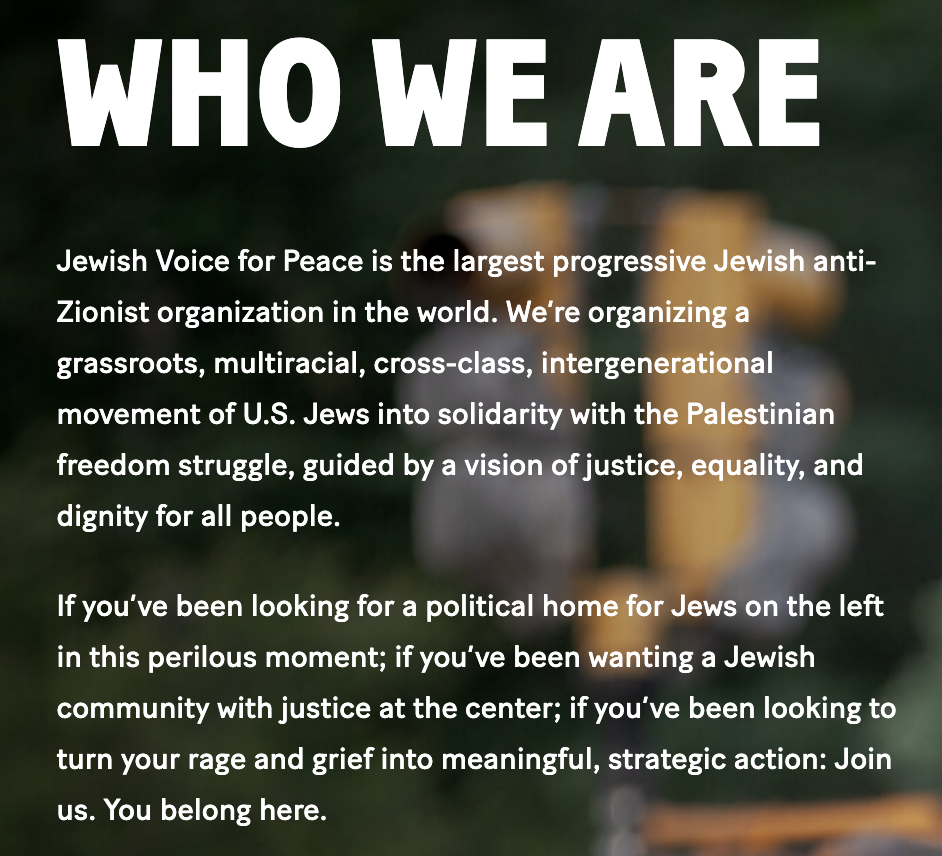
There is no need to invent a hidden agenda. Jewish Voice for Peace tells us quite openly what it believes. It is anti-Zionist. It is one of the first admissions you find on its website. When presented as integral to the brand and in brag format – it must be right! Right?
JVP is not merely anti-Netanyahu. It is not merely opposed to settlements or to particular Israeli policies. JVP declares its opposition to Zionism itself. It rejects the very framework through which Jews understand their right to national self-determination in their ancestral homeland, and it embraces a settler-colonial framing of Israel that recasts Jewish return not as indigeneity or national restoration, but as oppression. And while JVP speaks unequivocally of Palestinian liberation, Palestinian return and Palestinian freedom, you will search its stated vision in vain for an equally unequivocal affirmation that Israel should continue to exist alongside a Palestinian state as the national home of the Jewish people. Instead, when asked about the ultimate political arrangement, JVP says it is not its place to prescribe the outcome, preferring to advocate a “Judaism beyond Zionism.” That is a profound distinction for the nineteen-year-old who thought she was encountering simply a Jewish voice for peace.
That distinction becomes exceedingly important on a college campus. That proposition is what that 19-year-old will absorb in the name of PEACE and ending a WAR!
A student hears Jewish Voice for Peace and may reasonably imagine an organization occupying the traditional peace-camp position: two peoples, two national movements, compromise, coexistence, opposition to extremists on both sides. But that is not an accurate description of JVP’s political project.
JVP describes itself today as the world’s largest Jewish organization “supporting Palestine” and offers itself as a political home for Jews on the left.
It has approximately 44 Rabbis on its Rabbinical advisory council, all seemingly lending a hand in validation to the Jewish part. At least until July 26, 2026, it named those rabbis on its website. I took a screenshot and posted it on an article I wrote here last month. It seems that at the time of writing this, JVP has taken down the names of the people in the Rabbinical Council. I am wondering if it has something to do with my article where I exposed the JVP direct support of convicted terrorist, Rasmeah Odeh. (You will see the link at the end of this essay. )
While people are perfectly entitled to hold those beliefs, students are equally entitled to know what they are being recruited into.
Now Put Yourself Back on Campus
This is where the branding becomes consequential. Suppose another organization tells a Jewish freshman: Zionism is racism. She may recoil. Suppose she is told: Israel is a settler-colonial state. She may wonder whether that erases Jewish history and Jewish indigeneity. Suppose someone tells her: Israel is committing genocide. She may wonder whether that is an established legal judgment or an accusation being advanced as political fact. But now append four words: Jewish Voice for Peace says so.
The psychological equation changes. The organization’s Jewish identity becomes a kind of permission structure. It tells the non-Jewish student: You are not being antisemitic. Jews agree with you. It tells the progressive student: This position has already passed a Jewish moral test. And perhaps most importantly, it tells the uncertain Jewish student: You don’t have to choose between your progressive identity and your Jewish identity. Here are Jews telling you that rejecting Zionism is the more authentically just Jewish choice.
That is enormously powerful political organizing. And it deserves far more scrutiny than the organization’s congenial name ordinarily receives.
Then Came October 7
And here the chronology becomes impossible for me to ignore. On October 7, 2023, Palestinian Hamas terrorists attacked Israel, brutally massacred civilians, burned people alive, raped, mutilated, committed unspeakable savage atrocities, and then kidnapped hostages into Gaza, while proudly publishing their cruelty.
Before Israel’s subsequent military campaign had unfolded, before the arguments over proportionality, civilian casualties, humanitarian access, genocide that would consume the following months, JVP’s political apparatus was already moving.
- On the evening of October 7, JVP activists in New York joined a march to Senator Chuck Schumer’s home demanding an end to U.S. military funding for Israel.
- By October 8, JVP voices were already publicly placing what had happened within a narrative of Palestinian oppression and Israeli responsibility.
- By October 9, JVP Executive Director Stefanie Fox was explaining publicly that the violence had to be understood through what she described as 75 years of Israeli dispossession, discrimination and state violence.
- JVP’s own later account of this period says that in the days following October 7, “we could see what was coming, and we sprang into action together.”
Read that sentence again. They sprang into action.
That does not prove some sinister conspiracy. Nor do I need one. Something much more consequential was happening in plain sight. An existing ideological movement had the organization, vocabulary, activist networks and Jewish imprimatur necessary to interpret an event of almost unimaginable brutality virtually as it occurred.
And that interpretation was about to travel onto American campuses.
The Money Changed Too
Then something else happened. JVP became dramatically larger financially. Its publicly filed financial records show approximately $3.3 million in revenue in FY2023. The following fiscal year: approximately $11 million. What NGO gets to do that!
That is more than triple the previous year’s revenue. That fact demands examination, not conspiracy.
A fiscal-year return does not allow us simply to declare that $7.7 million suddenly materialized on October 8. It would be irresponsible to say so without tracing the timing and sources of contributions. JVP itself says that more than 85 percent of its annual budget comes from its members and individual supporters. Fine. Then let’s look.
Who funded the extraordinary expansion? When did the donations arrive? How much was institutional and how much individual? Which foundations contributed? How much of the growth occurred after October 7? And how was that money subsequently deployed? What was it spent on?
Those are not smear questions. They are the ordinary questions we should ask whenever a political advocacy organization experiences explosive growth while simultaneously becoming enormously influential in a national movement.
Especially when that organization is helping shape what students believe.
The Campus Expansion Was Real
JVP itself boasts about what followed. It says that as campus encampments spread across more than 100 universities, JVP student chapters participated in at least 47 of them. The organization says it added 30 new student chapters, expanded its campus organizing program, hired additional campus-organizing staff and eventually reached 50 campus chapters. Not exactly an organic grassroots expansion and on the back of October 07!
This is the part of the story I think many American Jewish parents have failed to understand.
Their children are not necessarily arriving at university and independently conducting scholarly investigations into Zionism, the 1948 war, the 1967 war, Palestinian nationalism, Hamas, international humanitarian law, and the competing historical narratives of two peoples.
They are walking into an already constructed political vocabulary, and an organization with a motive. And one of the organizations helping validate that vocabulary has the word Jewish stamped across its forehead.
That is the CON!
JVP provides a Jewish permission slip for a political movement overwhelmingly directed against the Jewish state.
Look Behind the Name
Then if we thought this was ominous, let us look at whom JVP has been prepared to elevate.
Look at its decision to honor Palestinian convicted terrorist, dubbed activist, Rasmea Odeh, despite her Israeli military-court conviction in connection with the 1969 bombing in a Jerusalem, super market just before Shabbos, that killed Eddie Joffe and Leon Kanner, college students, from South Africa and Uruguay, in their early twenties. Injuring many others.
Look at JVP’s relationships within the broader Palestinian-solidarity infrastructure. Look at Hatem Bazian, whom JVP itself acknowledges as a supporter: founder of American Muslims for Palestine and a central figure in the development of Students for Justice in Palestine. Then consider a revealing social-media episode from May 2023. Bazian posted from his own Twitter account a message apparently written in JVP’s collective Jewish voice, ending with the formulation, “As Jews…” Critics reasonably asked whether he had mistakenly posted material intended for JVP’s account. The episode does not, standing alone, prove that Bazian controlled or had access to JVP’s social-media account. But it certainly raises questions about the operational proximity between Bazian and an organization presenting itself to the public as an authentically Jewish voice , questions that merit investigation rather than dismissal.
OOPS!

Look at the partnerships. Look at the organizing. Look at the money. Look at the extraordinary expansion on American campuses. And then return to those three words:
Jewish Voice for Peace. The question is not whether the people involved are Jewish.
Many plainly are. The question is whether Americans have allowed an organization’s name to substitute for scrutiny of its ideology. Another question with eyes on Bazian – who are the actual ideological influencers?
I think we have.
And I think an entire generation of students has been exposed to some of the most loaded language in the Israeli-Palestinian conflict with the implicit reassurance that if a Jewish organization supplies or validates the terminology, the terminology has somehow already been vetted. That is not a reflection of student inadequacy. It is a reflection of how extraordinarily sophisticated modern political machinery can be.
And once this happens, something essential to university life is lost. The great promise of higher education is not to tell students what to think, but to teach them how to interrogate claims, test evidence, challenge orthodoxies, recognize propaganda, and resist the seduction of moral certainty. Yet when one cause comes prepackaged with its own vocabulary, its own moral hierarchy, and even its own Jewish seal of approval, critical thinking can give way to ideological conformity.
The danger is not only that students may be exploited or pulled into a selective cause so consuming that other injustices disappear from view. It is that they may be robbed of something even more precious: the habit of independent thought itself. And that is a terrible irony. A university should enlarge the mind. It should not teach students to surrender it.
More reading about Rasmea Odeh and Jewish Voice for peace: Here
——————————————————————————-
Thanks for reading! Subscribe for free -on SUBSTACK here

