Is Uganda paying an American lobbyist to sell the normalization of repression?
By Melanie Nathan, July 17, 2026,
When America’s own human rights record has become similar to Uganda’s, what exactly is Uganda paying an American lobbyist to sell? Reform, or the normalization of repression?
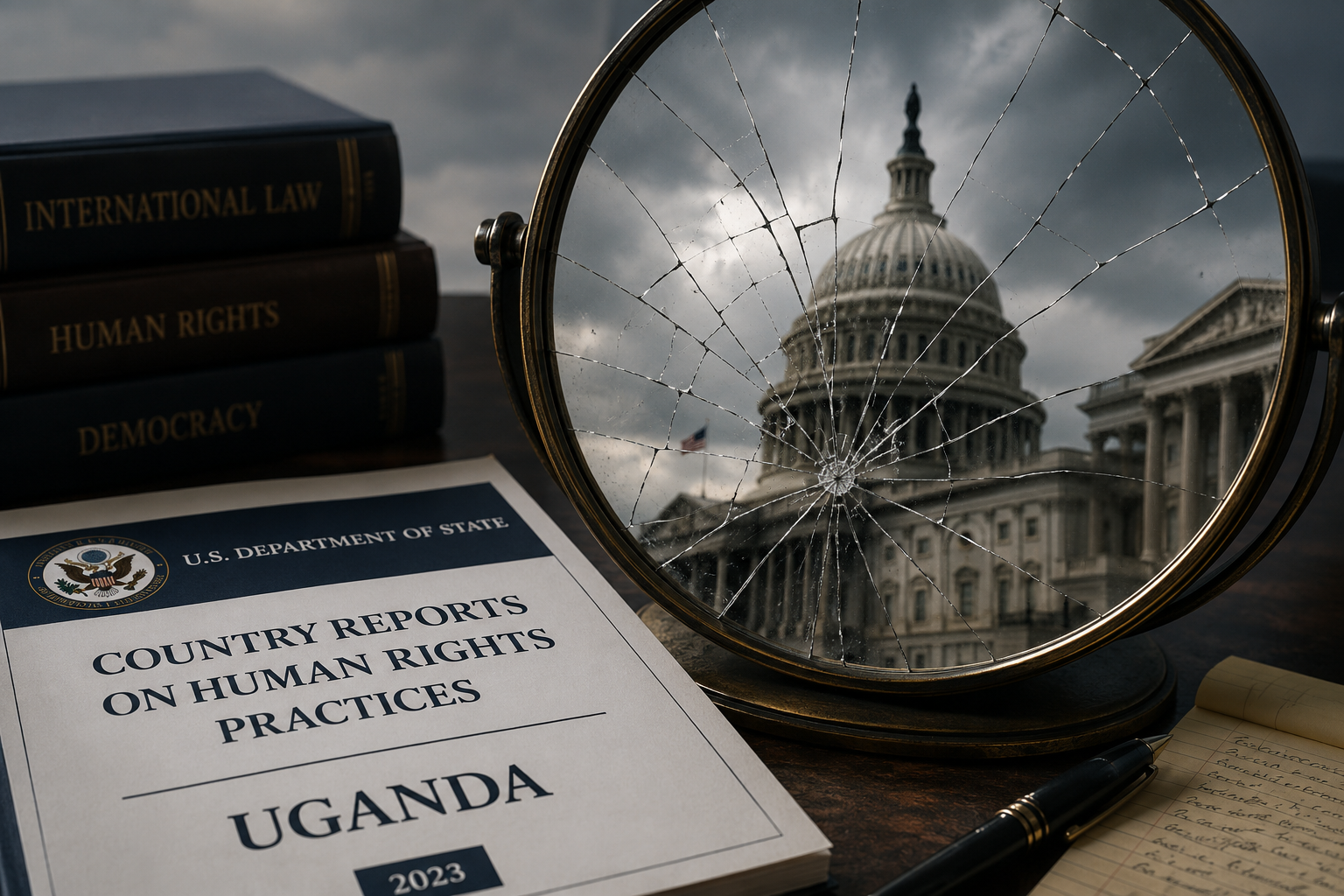
Uganda’s Embassy in Washington has retained Skyline Capitol, through Moran Global Strategies Inc., to provide lobbying, public affairs, and communications services for $20,000 a month. The filing, disclosed under the Foreign Agents Registration Act (FARA), comes as the United States continues to maintain a Level 4 “Do Not Travel” advisory for Uganda and keeps sanctions and visa restrictions in place against Ugandan officials for corruption and human rights abuses.
There is nothing unusual about a foreign government hiring lobbyists in Washington.
What is remarkable is the timing. Uganda is attempting to polish its image while the reasons it acquired that image remain fundamentally unchanged.
For decades, successive U.S. administrations, Republican and Democratic alike, have documented Uganda’s entrenched corruption, torture, arbitrary detention, suppression of political opposition, attacks on journalists, election violence, and shrinking democratic space. These were not “Biden reports” or “Trump reports.” The annual State Department Human Rights Reports are congressionally mandated. They simply reflected a persistent reality: Uganda’s human rights record had not materially improved.
What changed over time was the American response and America’s own landscape.
President Obama responded forcefully to Uganda’s 2014 Anti-Homosexuality Act, dubbed, “The Kill the Gays Bill.” President Biden dramatically escalated diplomatic pressure after Uganda enacted the far harsher Anti-Homosexuality Act of 2023, imposing visa restrictions, removing Uganda from AGOA trade benefits, and supporting broader international consequences.
President Trump’s first administration largely maintained the existing reporting framework while imposing targeted sanctions on individual officials for torture and corruption rather than broad country-wide measures.
His second administration has thus far prioritized ‘strategic cooperation’ over expanding human rights-based pressure. This administration has gone so far as to indulge in an unprecedented elimination of the LGBTQI+ and Women’s sections from the U.S. State Department reporting, entirely, leaving a gaping vacuum that can lead to all sorts of conclusions.
Meanwhile, Uganda remains one of the world’s most politically oppressed and dangerous countries for LGBTQI+ people. The Anti-Homosexuality Act imposes life imprisonment and, in some circumstances, the death penalty for consensual same-sex conduct. It criminalizes so-called “promotion of homosexuality” and has fueled violence, arbitrary arrest, dangerous detentions, blackmail, forced displacement, family rejection, and dangerous exile for thousands of LGBTQ Ugandans. Under President Yoweri Museveni’s four-decade rule, allegations of torture, disappearances, political repression, arbitrary detention, and state violence have become recurring features of Uganda’s general human rights landscape.
But this story is about more than Uganda. It raises a far more uncomfortable question:
What kind of America is Uganda lobbying?
Imagine, hypothetically, that the U.S. State Department of 2023 were asked to prepare a Country Conditions Human Rights report on the United States of 2026, using the same methodology it applies to other nations.
The report would likely discuss arbitrary immigration detention and deaths, killings during immigration enforcement, erosion of asylum protections, due process concerns, dangerous detention conditions, attacks on minority communities, restrictions affecting transgender people, threats to reproductive autonomy, constraints on protest, the devastating global human cost following the dismantling of USAID, and more.
No, America is not Uganda. Uganda remains an entrenched authoritarian state where homophobia and political repression is deeply institutionalized, and democratic institutions are profoundly weakened.
But as the United States has embarked upon a similar trajectory, the comparison is jaw dropping. The gap has narrowed in ways that would once have seemed unimaginable.
Which brings us back to Uganda’s lobbyists: Lobbyists can improve messaging. Public relations firms can soften perceptions. Neither can erase corruption, authoritarianism, torture, or the criminalization of human beings for who they are.
Yet if today’s United States increasingly judges foreign governments through a lens clouded by its own deteriorating human rights record, Uganda may reasonably conclude that reform is no longer the price of improved relations with Washington.
That is the real irony.
The question is no longer whether Uganda has or can change.
It is whether America has changed enough that Uganda believes it no longer has to.
————————————-
First Published: HERE
Subscribe here or on Substack.
Further about this Author:
Melanie Nathan, Executive Director of African Human Rights Coalition, is also an independent country conditions expert who prepares briefings, reports, declarations, and expert witness testimony for asylum, immigration, and human rights proceedings in the United States and internationally.
For two decades, her work has included documenting persecution and human rights conditions across Africa, particularly those affecting LGBTQI+ people, human rights defenders, women and girls at risk of gender-based violence, and other vulnerable populations. Drawing on extensive field experience and rigorous research, she assists courts, tribunals, and legal practitioners in evaluating claims involving persecution, state protection, forced return, third-country transfers, and future risk.

