Understanding Nigerian Muslims are not at war with Christians and vice versa….
By Melanie Nathan, Dec 26, 2025.
Each time violence linked to ISIS erupts in Nigeria, a dangerous shorthand resurfaces in international commentary: Muslims attacking Christians. This framing is not only false; it actively fuels the very instability extremist groups seek to create. Under Donald Trump, the United States has fallen squarely into this trap.
In announcing U.S. strikes, Trump framed the operation in explicitly religious terms, claiming ISIS militants were “viciously killing, primarily, innocent Christians,” and deploying incendiary language such as “terrorist scum,” while implying a civilizational confrontation rather than a counterterrorism operation. Defense Secretary Pete Hegseth echoed this framing in public remarks, emphasizing Christian victimhood without comparable acknowledgment that Muslim civilians and clerics are also among the insurgents’ primary targets. Major U.S. media outlets largely reproduced this framing in early headlines, foregrounding “Christian persecution” and presidential rhetoric.
 By contrast, Nigerian government officials and security authorities were unequivocal: the strikes targeted ISIS-linked extremists threatening all Nigerians—Muslim and Christian alike—and were not, and must not be interpreted as, a religious conflict. That divergence matters. When American leaders and media collapse terrorism into religion in the Nigerian context, they do not merely misdescribe events; they amplify the very narratives extremist groups rely on to fracture this pluralistic society from within.
This religious framing did not emerge spontaneously. In the weeks before ordering military action, Trump publicly accused the Nigerian government of “allowing the killing of Christians,” warned that the United States might intervene militarily if it did not stop, and suggested he could go into the country “guns-a-blazing.” He instructed the Pentagon to prepare for possible action while repeatedly reducing a complex security crisis to a narrative of mass Christian persecution. Nigerian officials firmly rejected this characterization, stressing that extremist violence affects all communities and that the government was working to protect both Christian and Muslim civilians.
 Nigeria is not fighting Islam. Nigeria is fighting violent extremist insurgents who exploit religion to pursue power, territory, and terror.
Nigeria is a country built on coexistence. It is a deeply religious nation, broadly divided between a predominantly Muslim north and a predominantly Christian south, with wide overlap and diversity in between. For generations, Nigerians of different faiths have lived side by side—intermarrying, trading, governing, and building communities together. In major cities and rural towns alike, religious identity has historically been less divisive than ethnicity, class, or politics.
This reality matters because it exposes a dangerous lie: Nigerian Muslims are not attacking Christians. They are not the drivers of mass violence; they are among its primary casualties. Yet U.S. Islamophobic narratives—amplified most aggressively during the Trump era—have deliberately blurred this truth, using fear of Muslims to prop up xenophobia and anti-immigrant policy. In doing so, they erase millions of Nigerians whose daily lives are defined not by extremism, but by ordinary pursuits: family, work, and the freedom to worship without being cast as suspects in someone else’s political theater.
The primary drivers of terror in northeastern Nigeria are Boko Haram and its offshoot, Islamic State West Africa Province (ISWAP), aligned with Islamic State.
These organizations have attacked churches and Christian villages; mosques and Muslim clerics who reject extremism; schools, markets, aid workers, displaced civilians—and, when exposed, LGBTI people. Their ideology condemns not only Christians but most Muslims as insufficiently “pure.” The objective is not religious dominance. It is control through fear.
ISIS did not emerge from Nigerian religious life. Its foothold grew from a toxic convergence of corruption, poverty, displacement, weak governance, regional arms flows following Libya’s collapse, and ISIS’s global strategy of franchising after battlefield losses in Iraq and Syria. ISWAP is not a Nigerian expression of Islam; it is a transnational extremist project exploiting local vulnerabilities.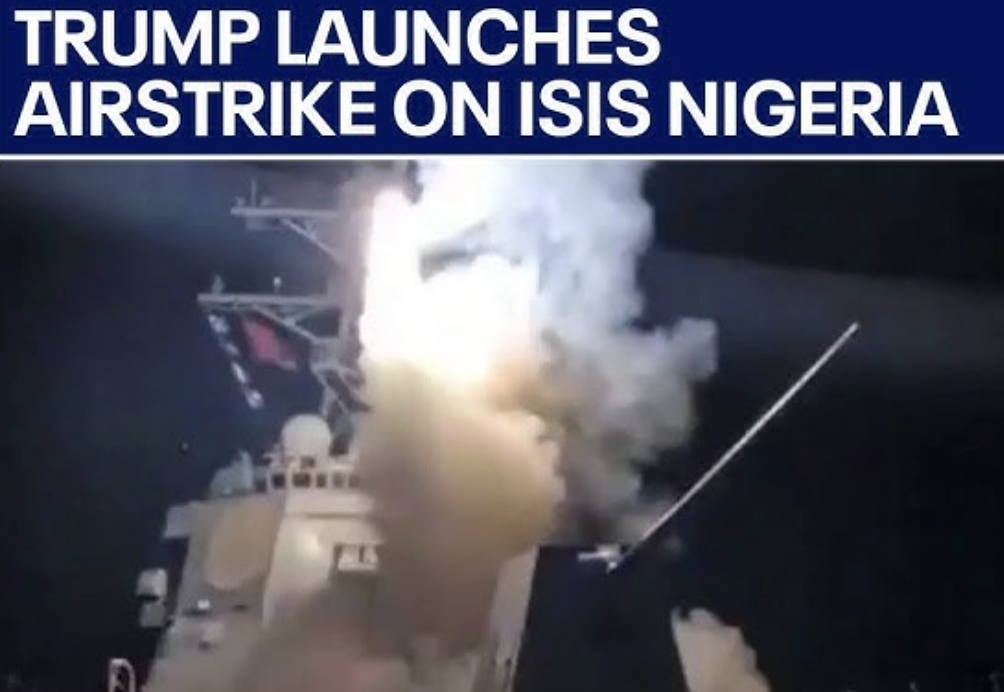
U.S. counterterrorism operations against ISIS-linked groups are not attacks on Muslims and must never be framed as such. Yet American rhetoric has too often been reckless. Bombastic language, spectacle-driven announcements, and civilizational framing—particularly under Trump—have blurred crucial distinctions.
Trump’s decision to announce U.S. military action via Truth Social, a platform he owns, was not a stylistic quirk but a substantive failure of leadership. It collapsed national security policy into personal performance, replacing clarity with spectacle and reinforcing the extremist narrative of “the West versus Islam”—a framing intelligence and counterterrorism experts have long warned strengthens ISIS far more than it protects civilians or advances regional stability.
The most serious risk of this misframing is not diplomatic confusion; it is violence within Nigeria itself. If foreign intervention is perceived as siding with Christians against Muslims, it risks inflaming north–south tensions, triggering retaliatory attacks, and fracturing communities that have long coexisted.
This is precisely the outcome ISIS seeks. Extremist movements thrive on polarization. They recruit through grievance and chaos, not theology.
Nigeria’s fight against terrorism requires military pressure and international cooperation—but it also requires allyship, not threats. True partnership demands linguistic discipline. Words shape perceptions, and perceptions shape violence. Conflating Muslims with extremists endangers civilians, undermines counterterrorism goals, and hands propaganda victories to ISIS.
Nigeria is not a religious battlefield. It is a pluralistic society under sustained assault by transnational extremist movements. Mischaracterizing that reality—especially through the rhetoric of powerful foreign leaders—does not merely confuse the public; it exacerbates risk for civilians and weakens counterterrorism outcomes. If the international community is serious about helping Nigeria, it must begin with disciplined truth-telling. Genuine partnership requires accuracy, restraint, and respect—starting with affording Nigerians the dignity and friendship owed to them as equal partners, not as backdrops for political theater.
Trump’s later characterization of the Christmas Day strike as “symbolic” made matters worse. In a fragile context, choosing Christmas and labeling the action symbolic reinforced a civilizational narrative extremists rely on to inflame division. When viewed alongside Trump’s repeated accusations that Nigeria “allows Muslims to kill Christians” and his broader record of policies aimed at excluding Muslims from the United States, the effect is deeply corrosive. It risks recasting counterterrorism as cultural confrontation and making U.S. force appear less like partnership and more like ideological warfare. If seen as Trump’s war on Islam, this advances the same narrative that underpins policies aimed at excluding Muslims from protection, refuge, and belonging. That is not leadership. It is precisely the kind of framing that endangers civilians, undermines allies, and hands extremists the narrative victory they seek.
By Melanie Nathan
I write this as a Country Conditions Expert on Nigeria
for asylum seekers in the US and Global Immigration Courts
 O-blog-dee-o-blog-da