By Melanie Nathan – December 21, 2025.
This essay is a call to rethink how LGBTQI+ funding is allocated in this time of unprecedented crisis, and to ensure that survival, not visibility, is treated as the first obligation of global solidarity. It is a call for partnerships from foundations, funders, donors and LGBTQI+ organizations.
A global humanitarian collapse is underway and LGBTQI+ people are being abandoned first. As U.S. foreign assistance is cut and Africa faces overlapping crises of war, famine, displacement, and disease, those already criminalized and erased are falling through every safety net at once. For LGBTQI+ people, survival is not delayed it is denied. Funding choices made by governments, foundations, and U.S.-based LGBTQI+ institutions now determine who eats, who receives HIV medication, who has shelter, and who dies quietly in hiding. This is not a failure of awareness; it is a failure of priorities. If the global LGBTQI+ movement continues to fund visibility over survival, solidarity will remain a slogan and people will die unseen.
The Guardrails have Fallen: How U.S. Aid Cuts Are Breaking LGBTQI+ Humanitarian Lifelines in Africa: The cutting of U.S. foreign assistance through USAID and allied humanitarian programs has not merely reduced funding lines on a spreadsheet. It has dismantled lifelines. And nowhere is the impact more devastating, more immediate, or more lethal than for LGBTQI+ people in Africa, who are already the most vulnerable among the vulnerable.
For organizations like African Human Rights Coalition (AHRC), these cuts translate directly into hunger, untreated illness, homelessness, forced hiding, and death. AHRC exists to do what almost no one else does: direct, rapid-response humanitarian intervention for LGBTQI+ Africans who cannot safely access mainstream aid systems. When the safety net collapses, we are not a “nice to have.” We are often the only place to turn.

A Crisis Within a Crisis: Africa is facing overlapping emergencies on a historic scale. Sudan is now the site of the largest humanitarian crisis on earth with millions displaced, food systems collapsed, health infrastructure obliterated. Across the region, conflict, climate shocks, and economic collapse have pushed entire populations into dependency on humanitarian assistance. This is but one of the many countries we serve.
Within those populations are LGBTQI+ people who are not only fleeing war and hunger, but also hiding from their own families, communities, and governments. Criminalization, vigilante violence, and state-sponsored persecution mean that many cannot enter refugee camps, register with authorities, or safely approach large international NGOs. Disclosure, the very thing required to receive protection, can be a death sentence.
There are no governments reaching these people. There are no mainstream NGOs designed to find them. There are no institutional systems that can safely serve them until they are somehow contained inside formal “protection environments”- and that is if they survive long enough to get there.
That is where AHRC comes in.
What Direct LGBTQI+ Humanitarian Work Actually Looks Like: When an LGBTQI+ person reaches out to AHRC, it is often at the very edge of survival. They are hungry. They are sick. They are homeless. They are hiding. They are terrified.We triage within 24 to 72 hours.
That means:
- Emergency food
- Safe shelter
- HIV medications and continuity of care
- Emergency medical treatment
- Relocation support
- Survival cash assistance
- Trauma-informed, identity-safe intervention
This is not theoretical work. This is not advocacy from a podium. This is not policy papers written at a distance. This is humanitarian rescue, quiet, fast, and lifesaving.
And yet, as global crises deepen, LGBTQI+ humanitarian funding is shrinking, not expanding.
The Lopsided Funding Reality: At precisely the moment when need is most acute, funding priorities are grotesquely misaligned. Hundreds of thousands of dollars are routinely allocated to:
- Executive salaries in the Global North
- Branding campaigns
- Gala appearances
- Corporate tracking systems
- Conferences about inclusion
Meanwhile, LGBTQI+ people are starving. People with HIV are losing access to medication.People in hiding are being evicted, arrested, or killed.
It is also worth confronting an uncomfortable reality about how limited resources are currently used. Each year, substantial sums are spent flying staff and speakers across continents, covering hotels, venues, and conference infrastructure so that organizations can convene, often to discuss the very crises described here. These gatherings have value, and coordination matters. But many of these conversations can now be held effectively and securely through remote platforms. The funds absorbed by a single cycle of air travel and accommodations could instead sustain food, safe shelter, and lifesaving medication for months, or even years, for people at immediate risk of starvation, illness, or violence. In moments of extreme humanitarian emergency, priorities must be ordered accordingly: convene when necessary, but feed and shelter first. Lives cannot wait for the next conference cycle.
We must ask the hard question: What should the pecking order of funding be during mass humanitarian collapse?
Is it defensible to spend $300,000 -$650,000 a year on a single U.S. based salary to maintain mission, visibility and donor relationships, while the same amount could feed, shelter, and medically stabilize hundreds of people facing imminent death?
This is not an argument against advocacy. It is an argument against abandonment. Its an argument for survival during times of catastrophe. Its an argument for Ubuntu. (‘I am because we are..’)
A Call for Shared Responsibility: LGBTQI+ organizations cannot afford to be isolated silos competing for scraps while crises explode around us. This moment demands collective responsibility from our “brother and sister” organizations, foundations, and institutions—especially those headquartered in the United States and Europe.
What would real solidarity look like?
- Guaranteeing a percentage of global LGBTQI+ funding for humanitarian response, not just advocacy and research.
- Redirecting a portion of existing grants to frontline organizations doing direct rescue work.
- Sharing mailing lists, platforms, and donor networks with small but high-impact organizations like AHRC.
- Adopting frontline groups as humanitarian partners, not treating them as peripheral actors.
- Committing to a simple model: take $1 out of every $10 raised and send it directly to LGBTQI+ humanitarian response.
The Moral Test of This Moment: Think of it this way: supporting AHRC is like dispatching a local fire rescue team to an earthquake zone halfway across the world. You do it because lives are trapped beneath the rubble and because you can.
The United States once served as a guardrail in global humanitarian response. As those guardrails fall, civil society must step forward. If U.S.-based LGBTQI+ organizations and foundations do not act now, history will record that we had the means to save lives—and chose comfort instead.
Share our stories.Adopt us as partners.Open your networks.Redistribute your resources.
PLEASE Just do it…
Because for LGBTQI+ people hiding in war zones, slums, prisons, and shadows—there is no time left for anything else.
 Funding in this space has never been easy, and the tensions around it are not new. Years ago, during a convening of LGBTQI+ leaders, I raised the question of global humanitarian responsibility and was met with a response many will recognize: that the LGBTQI+ community in the United States already carries more than enough violence, political backlash, and the erosion of legal protections at home.
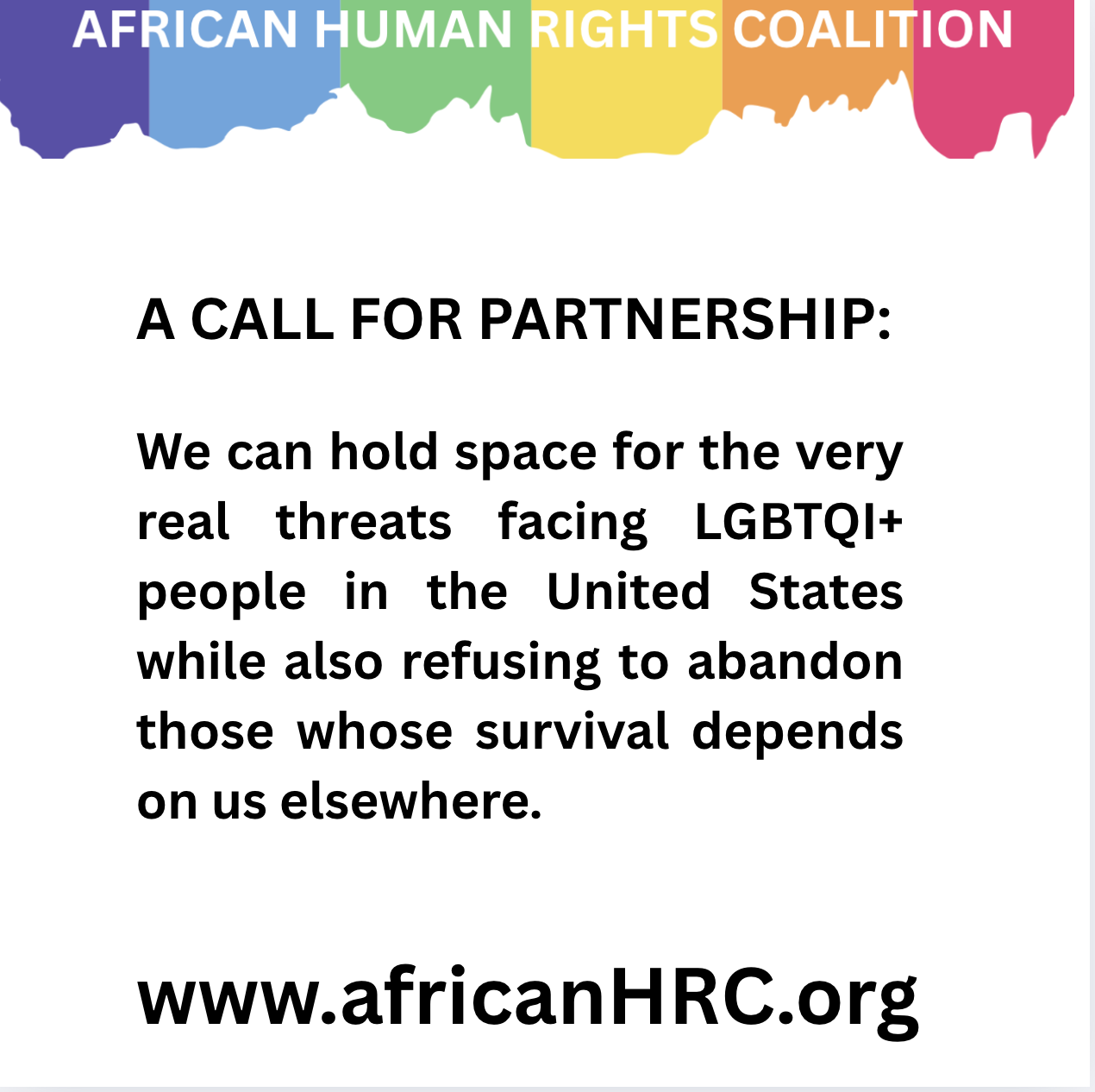
That concern is real, and it deserves acknowledgment. But the conclusion drawn, that care for those beyond our borders must therefore be deferred, misses a crucial truth. This is not an argument for choosing one crisis over another, nor a demand for disproportionate sacrifice. It is a call for partnership. We can hold space for the very real threats facing LGBTQI+ people in the United States while also refusing to abandon those whose survival depends on us elsewhere.
These responsibilities are not mutually exclusive and recognizing that is the starting point for the solidarity our moment requires. U.S. based LGBTQI+ communities should care about our global brothers and sisters because our safety, dignity, and hard-won rights have never existed in isolation. Every freedom we enjoy was built on the courage of people who were once criminalized, erased, and abandoned – many of whom had no refuge at all.
Today, LGBTQI+ people in Africa and other crisis zones stand where we once stood: hunted, silenced, and forced to survive underground. If we allow them to starve, to die without medicine, to be erased because they live beyond our borders, then our own victories become hollow. Solidarity is not charity; it is the recognition that an attack on LGBTQI+ life anywhere weakens protection everywhere. To defend our future, we must refuse a world where survival is determined by geography and we must act, now, while lives can still be saved.
AHRC Emergency Programs, Food and Shelter Programs: DONATE HERE
Contact for Partnership:
Melanie Nathan
commissionermnathan@gmail.com
Melanie Nathan is an internationally recognized expert on LGBTQI+ asylum and refugee protection in Sub-Saharan Africa and has previously been qualified as an expert witness in U.S. Immigration Courts and other international legal proceedings. As Executive Director of the African Human Rights Coalition (AHRC), she has worked directly with LGBTQI+ asylum seekers facing persecution, denial of refugee registration, and forced displacement across multiple jurisdictions. She provides expert country-conditions reports in support of asylum, withholding of removal, and Convention Against Torture (CAT) claims, including matters involving third-country removal and motions to pretermit.
 O-blog-dee-o-blog-da