The Policy, hate and laws we export—and ignore—boomerang back to our schools, courts, hospitals, and democracy. We cannot be silent!
By Melanie Nathan, Oct 16, 2025
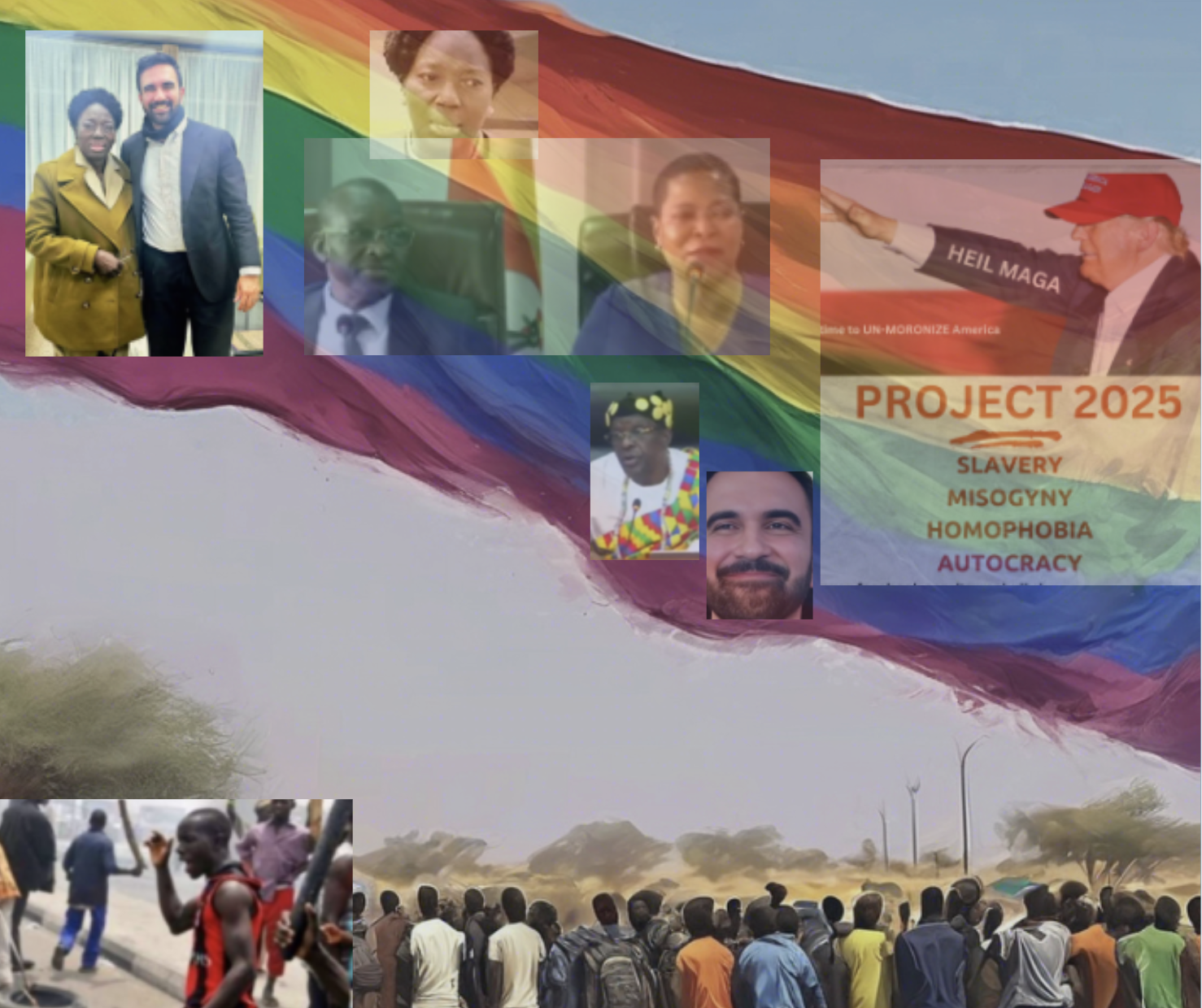
As Americans debate our own culture wars, and watch our democracy fail, a quiet crisis continues to unfold across Africa, destined to reflect our own doom: LGBT people are being hunted, imprisoned, tortured, and silenced under new “morality” laws spreading from Uganda to Ghana. These laws aren’t home-grown. They piggy back Colonial era penal codes, often exported, funded, or blessed by American extremists who repackage bigotry as “family values” for export. Their success overseas is a test case for what they hope to bring back home.
Some parts for Project 2025 – designed in the United States, manufactured in Africa, and returned home, newly minted, for application.
This matters because persecution anywhere undermines liberty everywhere. It threatens U.S. investments in health and education, destabilizes allies, drives refugee flows, and corrodes the rule of law that underpins democracy. It also tears at our moral credibility when we preach freedom while our own citizens bankroll repression.
Add now – the new American World order, a diminishing human rights framework, having lost much of the American guardrail, all in a mere 9 months!
America’s LGBTQI community is global. African queer people seeking safety end up in our asylum system, our churches, our mosques, our schools, our cities. Their struggle is part of ours. Standing with them affirms not just compassion but the American promise itself—that no one should be punished for who they are or whom they love. If we fail to care, we concede that equality is negotiable. If we act, we prove it is universal.
Even amid our own hardships, Americans can act: So call your representatives to support asylum protections, and refugee pathways, amplify African voices online, donate to vetted human-rights groups, and challenge hate wherever it appears. Solidarity is not a luxury, it’s our moral inheritance. Defending others’ freedom is how we safeguard our own. To add to this we must hold our politicians accountable for moral clarity and action. We must hold our clergy accountable for calling out those among them who care less or cause harm.
To Nail it down further think about this:
Americans should care deeply because what’s happening to LGBTQI+ Africans isn’t “over there.” It touches U.S. values, interests, communities, and systems right here.
- It’s a test of American values.
If equality and freedom from persecution mean anything, they mean defending them beyond our borders, especially when U.S.-based actors, dollars, or platforms help fuel the harm (from exported hate to online mobs). Silence undercuts U.S. credibility on human rights everywhere. - Contagion of bad laws and ideas.
Anti-LGBT playbooks travel. Tactics pursued or piloted in one country, broad “morality” bills, criminalizing identity, “anti-propaganda” clauses, censorship, regularly jump borders and then boomerang into U.S. school boards, statehouses, and platforms. Lest we forget President Museveni of Uganda called upon all African leaders to “save the world from homosexuality,” and many are trying to oblige. - Diaspora is us.
Millions of African-born and African-descended Americans have family directly affected. This is not foreign; it’s family, remittances, funerals, and forced migration decisions felt in U.S. churches, mosques, campuses, WhatsApp groups, and neighborhoods. - Refugee and asylum systems are U.S. systems.
When persecution spikes, more people seek safety. That becomes a U.S. policy question: adjudications, backlogs, community sponsorship, healthcare, and integration costs and responsibilities we already bear. Caring upstream reduces suffering and downstream strain. - National security & stability.
Rights crackdowns correlate with broader authoritarian trends, surveillance, disinfo, militias that destabilize regions, complicate counter-terrorism partnerships, and drive displacement. Instability doesn’t stay put; it shapes U.S. security and aid agendas. - Public health spillovers.
Criminalization drives people underground and undermines HIV prevention and care. It disrupts broader health systems (clinics shutter, staff threatened, data suppressed). Epidemics don’t respect borders, and U.S. investments (PEPFAR, NIH collaborations) are jeopardized when key populations are hunted. Not to mention how the U.S. has now cut off such AID will impact the global goal to eradicate HIV by 2034. - U.S. economic and tech interests.
American companies operate, hire, and build supply chains across Africa. Persecution chills talent mobility, raises operational risk, and puts LGBT employees and customers in harm’s way becoming a governance, ESG, and brand safety issue for U.S. firms. - Rule-of-law and democracy.
Once states criminalize identity, the same machinery is readily aimed at any of the “other” – LGBTQI+ Americans, journalists, women’s rights defenders, opposition parties, Jews, Muslims, and courts. Supporting LGBT rights abroad is part of safeguarding pluralism and rule-of-law that Americans say they want in partners. - Moral leadership matters.
When the U.S. uses diplomatic voice, targeted assistance, and sanctions thoughtfully, it saves lives and stiffens spines of local defenders. When we don’t, persecutors read it as a green light. We must follow the lead of activists in their own countries. - It’s the same fight.
The rhetoric, funders, and bills attacking LGBT Africans and those targeting trans and queer Americans often overlap.
Let’s not kid ourselves, this is not a foreign problem; it’s a mirror. What is tested on African soil today is rehearsed for the U.S. tomorrow. The machinery of moral panic, sanctified by pulpits and polished by think tanks, has no borders. If we shrug while others are branded, beaten, and erased in our name, we are only rehearsing our own undoing.
The United States once helped write the Universal Declaration of Human Rights, a moral compass for a broken world. Today, we are watching that compass spin wildly, hijacked by those who confuse cruelty for conviction. The “Project 2025” ideology is not content to dominate one nation, it seeks to franchise repression, akin to its Jihadist cousin. Its beta test is in Kampala, Accra, Lagos; the final rollout is meant for Kansas, Texas, and Tallahassee.
So the choice is ours: either we reclaim America’s moral imagination, or we watch it exported, repackaged, and re-imported as our own oppression. The fight for African queer lives is not charity, it is self-defense for democracy itself.
If we fail to stand up now, we will soon find the same laws, the same hate, the same silence coming home, wearing our flag.
Or is it already happening?
We must also act with consciousness and humility. Supporting LGBTQI+ Africans cannot become another exercise in moral colonization. The goal is not to speak for Africa but to stand with our LGBTQI+ African family, to amplify, resource, and support those already risking everything on their own soil. African activists, lawyers, journalists, and faith leaders are leading the fight; our role is to ensure they are not silenced or starved of support. True solidarity means listening first, funding local leadership, and defending their right to shape their own liberation. Justice exported from Washington is fragile; justice built in Nairobi, Kampala, Accra, and Lagos is enduring.
It also means that if you are a naturalized American counted as Diaspora, and politically or celebrity platformed, you have an absolute duty to speak out, unconditionally, and clearly to condemn injustice and human rights abuses on the Continent.
By Melanie Nathan
Country Conditions Expert
Uganda, Kenya, Ghana, South Africa
and other African Countries
commissionermnathan@gmail.com
 O-blog-dee-o-blog-da