Posted by Melanie Nathan, AUG 30, 2024.
Matthew Miller, U.S. State Department Spokesperson:
The Department of State is taking steps today to impose visa restrictions on individuals responsible for, or complicit in, undermining and impeding a sustainable peace in South Sudan. These individuals, who include members of the South Sudanese government, participated in obstructing life-saving humanitarian aid through the taxation of aid shipments. These persons may be found ineligible for entry into the United States.
The United States remains deeply concerned about the South Sudan transitional government’s failure to act with urgency to establish a clear and consistent system for full implementation of its obligations under the 2018 peace agreement, in particular, its obligation to create an enabling political, administrative, operational, and legal environment for the delivery of humanitarian assistance and protection.
Despite assurances, the government has yet to effectively reduce the unacceptably high costs, bureaucratic obstacles, and risks of providing humanitarian assistance to South Sudanese people in need. This raises questions about its willingness and capacity to abide by its 2018 peace agreement commitment to create an enabling environment for the delivery of humanitarian assistance and protection.
The Department of State’s steps to impose visa restrictions were taken pursuant to Section 212(a)(3)(C) of the Immigration and Nationality Act, under a policy announced in 2019.
-
Refugees and internally displaced peopleAs of May 2024, there were an estimated 2.28 million people who had fled South Sudan to neighboring countries, and 2 million people who were internally displaced. 4 Million are displaced including internally displaced. Approx 400,000 killed.
-
Vulnerable populationsThe most vulnerable people, including children, women, the elderly, and disabled people, have been the most affected by the crisis.
-
Food insecurity and starvationIn 2017, famine was caused by fighting in the country’s agricultural heartland, which led to 6 million people facing starvation.
-
Economic devastationThe country’s economy was devastated, with real income halving since 2013 and inflation over 300% per year.
-
Climate changeClimate change has also contributed to the crisis, with droughts and floods affecting rural communities who rely on subsistence farming.
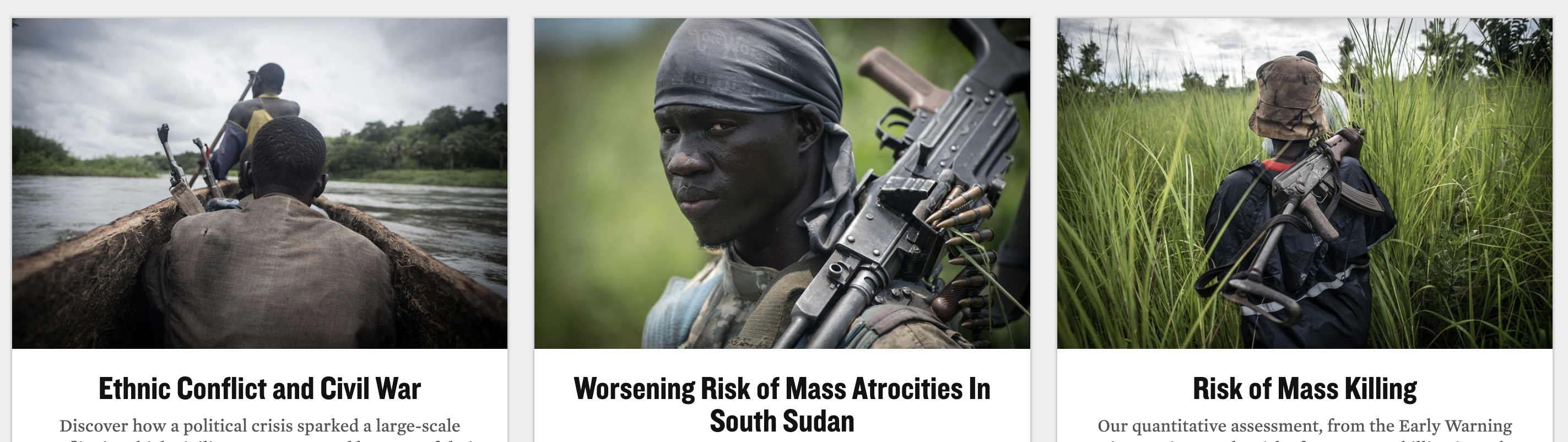
Kind of an irony that the Holocaust Museum is one of few American institutions calling attention to a very silent America, about the ethnic conflict in South Sudan, and resulting humanitarian catastrophe. Seems American campuses have no interest in Africa – I mean there are no Jews to blame! So yeah – So Yeah!
U.S. Holocaust Museum:
“Since gaining independence from Sudan in 2011, the new nation of South Sudan has experienced civil war and mass atrocities against civilians, including widespread sexual violence, murder, and forced displacement. Multiple attempts at peace agreements have been made, and largely stalled. These delays contribute to conflict and violence across the country—violence which sparked warnings of genocide in 2016. Between 2013 and 2018, over 400,000 people were killed as a result of the war. In March 2017, the United Nations Human Rights Commission determined that ethnic cleansing was occurring. The civil war has formally ended, but in 2020 there was an increase in both intercommunal and politically motivated conflicts. Explore the history behind the ethnic conflict and the current risks of mass atrocities that civilians face.”

BY MELANIE NATHAN
EXECUTIVE DIRECTOR
AFRICAN HUMAN RIGHTS COALITION
COMMISISONERMNATHAN@GMAIL.COM
 O-blog-dee-o-blog-da