By Melanie Nathan, April, 05, 2024.
As if the harm directly on African soil by American Evangelicals pushing for deathly anti-Homosexuality Bills is not enough, in the summary released describing the basis for their ruling, the Ugandan Constitutional Court only cited one case by name: the U.S. Supreme Court ruling striking down the right to abortion, Dobbs v. Jackson, as providing justification for upholding criminalization of LBTIQ+ Ugandans.
It would thus be appropriate to deduce that SCOTUS has effectively participated in applying not only the justification for the criminalization of gays, lesbians, bi, trans and queer people, but also the DEATH PENALTY in certain instances, as provided for in the Ugandan law.
The case will be appealed by petitioners to the Ugandan Supreme Court.
This could also impact how other African courts view respective constitutional challenges to their new enhanced anti-homosexuality legislation, such as that currently before Ghana. It may also serve to empower and motivate other countries who have yet to legislate new and heightened anti-gay legislation, such as Kenya and Senegal and more…
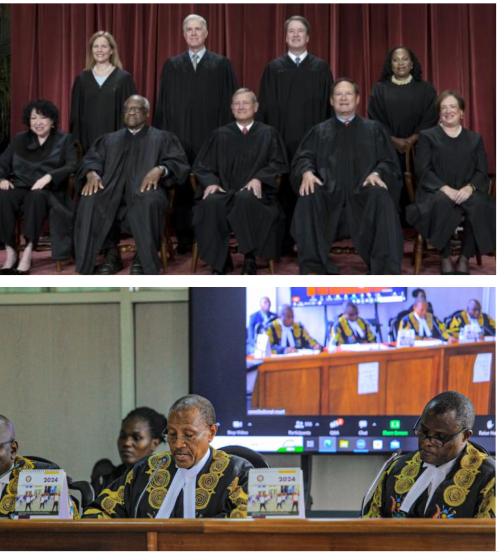
CFE, A coalition of advocates working through The Convening for Equality group with a co-convener a petitioner in the case, has released a statement – below. This post includes the analysis provided by lawyers representing the petitioners.
The full judgment can be accessed here: GO TO AHRC WEBSITE.
The Convening for Equality (CFE) issued a statement following the judgment: Uganda’s Constitutional Court Fails to Repeal the Anti-Homosexuality ActAppeal to Supreme Court Planned
(Kampala – April 3, 2024)
Today, Uganda’s Constitutional Court struck down only two sections and two subsections of the Anti-Homosexuality Act and unanimously ruled that the rest of the Act was constitutional.
The Court stated some sections violate the right to health, right to privacy, and right to freedom of religion but failed to identify the numerous ways the law violates Ugandans’ substantive rights to equality, dignity, speech, association and health, and freedom from discrimination.“While we respect the court, we vehemently disagree with its findings and the basis on which it was reached. We approached the court expecting it to apply the law in defense of human rights and notrely on public sentiments, and vague cultural values arguments. ,” said Nicholas Opiyo of Chapter Four, Uganda.
The lives of Ugandan LGBTQ individuals are now in further peril for the ruling of the court.
These petitions were filed to protect all Ugandans, including sexual and gender minorities. Uganda’s Constitutional Court had the opportunity to uphold the constitutional rights of the people and also follow the examples of other African countries with a rich cultural fabric, such as Mozambique, Botswana, Seychelles, Mauritius, Gabon, Cape Verde, South Africa and Angola.
Those countries have recognized anti-gay laws as remnants of colonial rule, and repealed them through law reform processes and court decisions. Their actions set a precedent that should have guided Uganda to be on the right side of history and decolonize Uganda’s laws and policies.
“This ruling is wrong and deplorable,” said Frank Mugisha, of Sexual Minorities Uganda and
CFE-Co-Convener . “Uganda’s Constitution protects all of its people, equally. We continue to call for this law to be repealed. We are calling on all governments, UN partners, and multilateral institutions such as the World Bank and the Global Fund to likewise intensify their demand that this law be struck down because it is discriminatory. This ruling should result in further restrictions to donor funding for Uganda–no donor should be funding anti-LGBTQ+ hate and human rights violations.”
In the summary released describing the basis for their ruling, the Court only cited one case by name: the U.S. Supreme Court ruling striking down the right to abortion, Dobbs v. Jackson, as providing justification for upholding criminalization of LBTIQ+ Ugandans.
Advocates noted that this could point to influence on Uganda’s Judiciary by the U.S. extremist hate groups who funded that U.S. Supreme Court challenge.
The Court cited the right to health in striking down a provision requiring reporting of LGBTQ+ people.“This is sheer hypocrisy. We are appalled that the Court wrapped its ruling in language on upholding Uganda’s constitutionally enshrined right to health,” said Richard Lusimbo, Director General of the Uganda Key Populations Consortium and CFE Co-Convener. “Reinforcing LGBTQ+ criminalization entrenches negative biases against our community by the general public, including those very health care workers that are mandated to treat us, which will result in the inevitable denial of health services despite the thinly veiled attempt to placate us. Removing the provision on reporting us to the police will not protect us from discrimination in the health sector. This partial nullification is merely window dressing designed to try to persuade donors to restart funding.”
This odious Act, passed by the Parliament of Uganda and assented to by the President a year ago, has led to state-sanctioned witch hunts targeting LGBTIQ+ people both physically and online, despicable and false accusations of LGBTIQ+ and institutionalized systematic violation of the human rights of those already pushed to the margins of society. There have been over 180 cases of evictions, 18 case of forced anal examinations, 176 cases of violations of torture, 159 cases of violations of the right to equality and freedom of discrimination, and 102 hospitalizations directly linked to the violations. And these are only the reported and documented incidents. With today’s ruling, these types of human rights violations will continue.
The Anti-Homosexuality Act is unconstitutional and immoral, said the Convening for Equality (CFE). It deprives Ugandan citizens of their rights to liberty, life, security, and dignity. It exposes them to
torture, inhuman and degrading treatment, which are all prohibited under Chapter Four of the Uganda Constitution.
We vehemently disagree with the Court’s findings and refusal to repeal the Act. We challenged the lawin the Constitutional Court because of the numerous ways in which the law allows violence and
discrimination and criminalizes conduct that even allows us to fight for our rights,
“The Ugandan Judiciary cannot legislate the Ugandan LGBTIQ community out of existence,” said Clare Byarugaba, of Chapter Four Uganda and CFE Co-Convener. “We shall continue to pursue all legal means to ensure that the abhorrent law is repealed in all its entirety. Our Human Rights are inherent and non negotiable.”As the political and religious vitriol, scapegoating, and state-sanctioned violence against gender and sexual minorities continue to take root in Uganda and many parts of Africa; WE must all remember that the moral fabric of Uganda and Africa does not hinge on criminalizing and legalizing the witch hunt of already marginalized groups within society but by ensuring that those mandated to protect human rights, justice and law are:
● Equipped with the right information, tools and integrity that promotes good governance,
● are independently committed to promoting human rights, and that dignity remains inherent to all human beings as guaranteed by the Constitution of Uganda.Lead Counsel – Nicholas Opiyo, Chapter Four Uganda, in Kampala Onyango Owor, Partner, Onyango AdvocatesCFE Co-Conveners; Frank Mugisha; Clare Byarugaba; Richard Lusimbo;
SEE ALL LINKS to HRAPF Analysis of the Ruling, the full ruling, to INCLUDE LINK TO THE ACT WITH NOW INVALID CLAUSES CROSSED OUT
COUNTRY CONDITIONS EXPERT WITNESS CONTACT:
Melanie Nathan, nathan@AfricanHRC.org
Melanie Nathan, Executive Director of African Human Rights Coalition is a qualified country of origin expert witness in the United States and global immigration courts, providing expert written country conditions reports and testimony for lesbian, gay, bisexual, transgender, queer, intersex, non-binary, LGBTQI + asylum seekers from African Countries, such as Uganda, Ghana, Angola, Kenya, and more… HERE
Melanie also consults multinational corporations regarding briefings and policy for operations and issue impacted by anti-homosexuality laws and country conditions. SEE HERE

 O-blog-dee-o-blog-da